

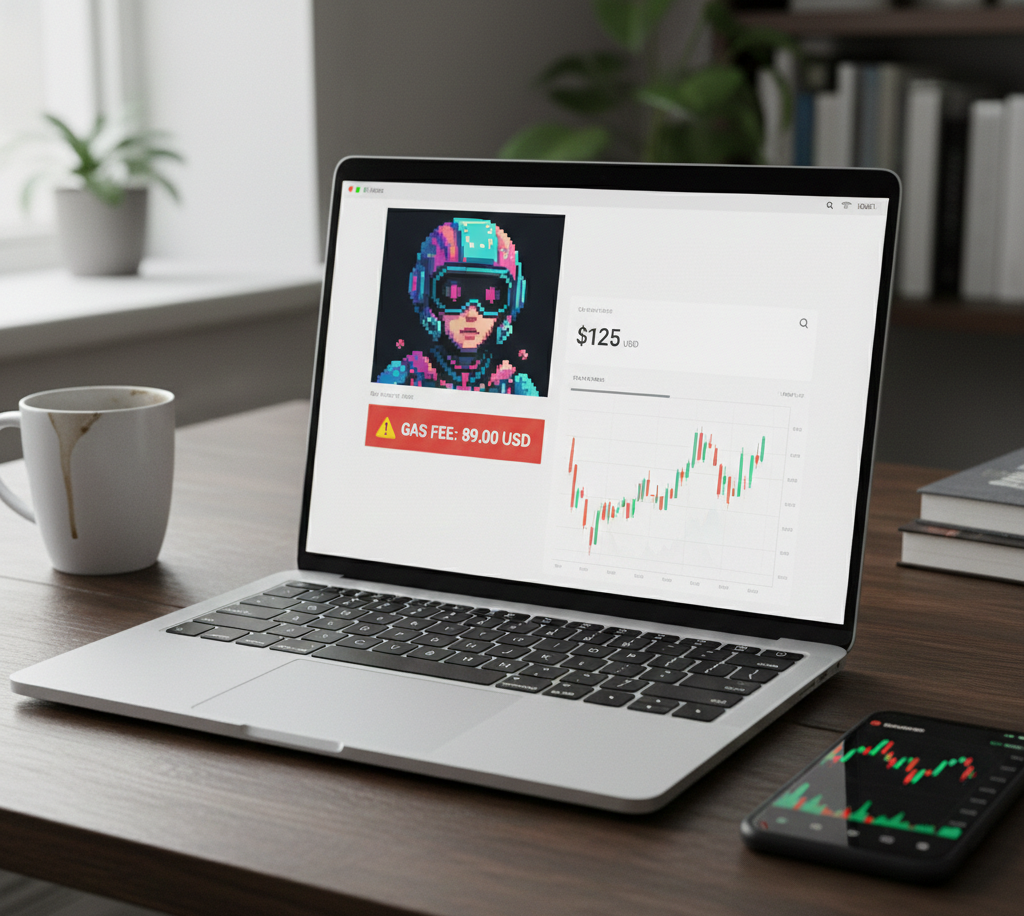
If you’ve ever tried buying your first NFT and suddenly saw a $78 “gas fee” on a $40 purchase… you probably felt confused. Maybe even annoyed.
You’re not alone.
For many beginners in the United States, gas fees are the moment crypto stops feeling exciting and starts feeling expensive.
So what exactly is a gas fee in NFT?
And why does it sometimes cost more than the NFT itself?
Let’s break this down in a way that actually makes sense.
First: What Is a Gas Fee in NFT?
Gas fees are transaction costs paid to the Ethereum network to process and validate blockchain transactions, as explained in the official Ethereum documentation.
Every time you:
- Buy an NFT
- Mint an NFT
- Transfer an NFT
- List an NFT for sale
You are asking the blockchain network to process your request.
Gas fees are the payment to the network validators (or miners) who confirm and secure that transaction.
Think of it like paying tolls on a highway.
You’re not paying the NFT creator.
You’re paying for the road that moves your transaction forward.
Why Is Gas So Expensive Sometimes?
This is where emotions usually enter the story.
Gas fees increase when the Ethereum network becomes congested, something you can track in real time using tools like Etherscan’s gas tracker.
And in 2026, the Ethereum network gets busy a lot.
When:
- A popular NFT collection drops
- A big crypto market move happens
- Traders rush into DeFi
- Meme coins explode
Everyone is trying to use the network at once.
The system works like an auction.
The more people bidding to get their transaction processed quickly, the higher the fee becomes.
So if you want your NFT purchase to go through immediately, you may need to outbid others.
That’s why gas fees spike.
It’s supply and demand — but for transaction space.
Why Gas Fees Feel So Personal
Here’s something most articles don’t admit:
Gas fees feel unfair when you’re new.
You see:
NFT price: $120
Gas fee: $96
And it feels like you’re being punished.
But what’s really happening is:
You’re paying for decentralized security.
No bank.
No central authority.
No single company controlling the transaction.
That security comes at a cost.
And in the U.S., where many retail investors are entering NFTs with smaller budgets, gas fees hit harder emotionally.
It feels like friction.
It feels like waste.
But it’s infrastructure.
Read More : What NFT Should I Buy in 2026? A Smart Beginner’s Guide (Without the Hype)
What Determines the Cost of Gas Fees?
Several factors affect NFT gas fees:
1. Network Congestion
More users = higher fees.
2. Time of Day
Late-night U.S. hours sometimes have lower activity.
Weekends can vary.
3. Complexity of the Transaction
Minting can cost more than simple transfers.
4. Ethereum Price
If ETH rises, gas fees feel more expensive in USD.
Are Gas Fees a Scam?
Short answer: No.
But they are misunderstood.
Gas fees are transparent and visible on the blockchain.
You can even check current gas prices before confirming a transaction.
They fluctuate based on real-time demand.
However, beginners often make one mistake:
They rush.
They mint during hype.
They buy during peak traffic.
And that’s when fees explode.
How Beginners in the U.S. Can Lower Gas Fees
If you’re buying NFTs in 2026, here’s practical advice:
✔ Avoid minting during viral drops
✔ Check gas trackers before confirming
✔ Consider Layer 2 networks (like Polygon)
✔ Be patient instead of chasing hype
Sometimes waiting 20 minutes can cut fees in half.
Patience saves money in crypto.
Why Gas Fees Actually Protect the Network
This is the deeper part.
Gas fees prevent spam.
Without fees, bots could flood the network with fake transactions.
Gas creates economic friction — and friction creates security.
In that sense, gas fees are not just a cost.
They are part of what keeps the blockchain reliable and decentralized.
The Emotional Reality of Paying Gas
Every new NFT buyer goes through the same cycle:
Excitement → Surprise → Frustration → Understanding
Once you understand what gas fees represent, they stop feeling random.
They become predictable.
And once something is predictable, it becomes manageable.
That’s when you stop reacting emotionally and start thinking strategically.
Final Thought: Gas Fees Are the Entry Lesson
Gas fees are usually the first real lesson in crypto.
They teach:
Timing matters.
Hype is expensive.
Infrastructure isn’t free.
If you understand gas fees, you understand how blockchains function at a deeper level.
And that’s when you stop being just a buyer — and start becoming informed.
Written for U.S. readers navigating NFTs in 2026 — without hype, without fear, and without confusion.