
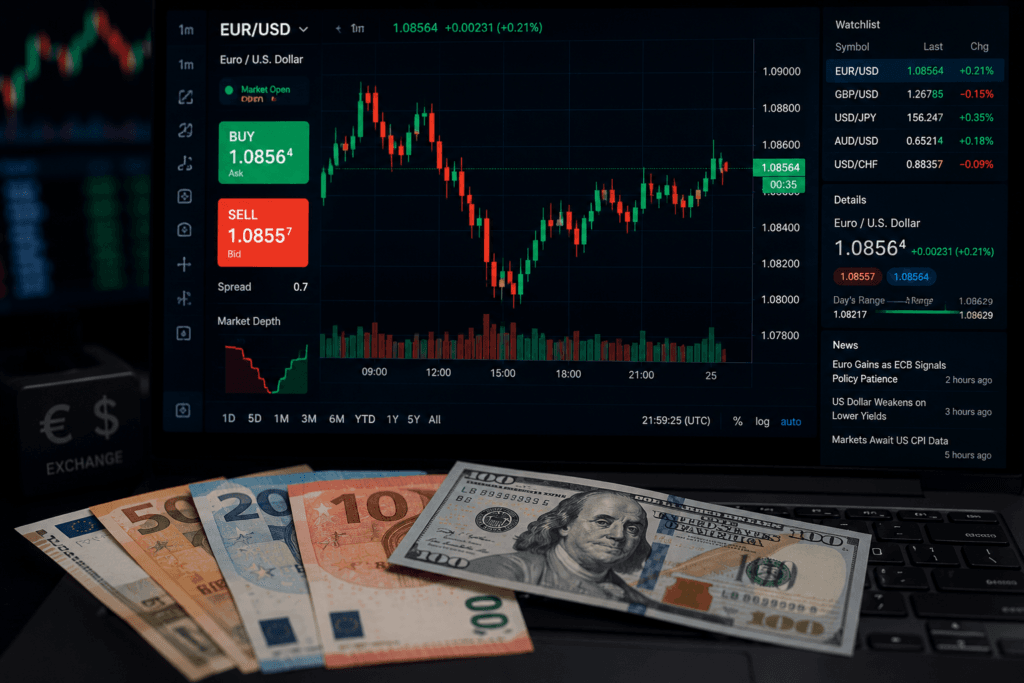
EUR/USD has spent most of 2026 in a story that comes down to one number: the interest rate gap between the Federal Reserve and the European Central Bank.
As of mid-June 2026, the pair is trading around 1.167 — well below its January 2026 high near 1.2019, but holding firm against renewed dollar strength. According to Cambridge Currencies’ June 2026 forecast update, the euro currently sits toward the softer end against the dollar around 1.167, trading below its January high of 1.2019, with the June 11 ECB decision the dominant near-term driver.
The entire EUR/USD trade for the rest of 2026 hinges on one mechanism: whether the rate differential between the two central banks continues to narrow. Here’s the complete picture as of mid-June.
The Single Number That Explains Everything: The Rate Differential
According to BitMEX’s detailed April 2026 EUR/USD analysis, every driver connects back to the rate differential — whether growth divergence, central bank policy, or geopolitical shocks repricing risk — the EUR/USD trade in 2026 comes down to whether the gap compresses or widens, and the rate differential has narrowed from over 225 basis points to approximately 162 basis points, with further compression favoring the euro.
Here’s why that matters in plain terms: when US interest rates are much higher than European rates, investors get paid more to hold dollars than euros — which strengthens the dollar and weakens EUR/USD. When that gap narrows — either because the Fed cuts or the ECB holds/hikes — the incentive to hold dollars over euros shrinks, and the euro tends to strengthen.
That’s exactly the dynamic playing out in 2026.
What the Fed Is Doing
The Fed cut rates three times in 2025, bringing the target range to 3.50%–3.75%. According to BitMEX’s analysis, futures pricing as of April 2026 implies one to two more cuts this year, potentially bringing the rate to 3.00%–3.25% by December.
This inflation stickiness is the same dynamic that drove the hawkish June FOMC dot plot affecting gold and broader markets — the Fed is genuinely torn between supporting growth with cuts and fighting inflation that refuses to fully cooperate.
What the ECB Is Doing
The European Central Bank has held its deposit facility rate at 2.00% since June 2025 — a ten-month pause after four consecutive 25 basis point cuts earlier that year. According to BitMEX’s research, that pause is doing the euro a favor — whilst the Fed has continued cutting, the ECB’s hold keeps the European side of the rate differential stable, meaning any narrowing comes from the US side.
Now, heading into mid-June 2026, there’s a genuine possibility the ECB does more than hold. According to Cambridge Currencies’ analysis, an ECB hike on June 11 is largely priced in by markets, making the bigger swing factor what the dollar does next. Polymarket pricing as of the analysis period reflected expectations of no change to rates until June 11, 2026, with a 25 basis point increase priced in for that meeting.
If the ECB actually delivers a hike while the Fed continues cutting, that’s a direct, mechanical tailwind for EUR/USD — the rate gap compresses from the European side this time, not just the US side.
Eurozone inflation data supports the ECB’s cautious stance. Headline inflation fell to 1.9% in December 2025, dipping below the ECB’s 2% target for the first time since mid-2025 — though core HICP, excluding food and energy, stood at 2.3%, with the ECB wanting core closer to 2.0% before considering further easing, and services inflation, still above 3%, remaining the sticking point.
Current Technical Picture: Key Levels for June 2026
According to RoboForex’s June 2, 2026 EUR/USD technical update, the pair is recovering after dipping a day earlier, currently standing at 1.1648, bolstered by weaker demand for the US dollar amid rising geopolitical tensions in the Middle East.
Resistance Levels
| Level | Significance |
|---|---|
| 1.1665 | Near-term resistance — RoboForex June 2 |
| 1.1685 | Key resistance — breakout signals dollar weakness, RoboForex |
| 1.1700 | Confirmation level — consolidation above reverses bearish momentum |
| 1.1785 | Next target if 1.1685 clears with conviction |
| 1.20 | Major psychological level and 2026 ceiling target zone |
| 1.2019 | January 2026 high |
Support Levels
| Level | Significance |
|---|---|
| 1.1605 | Key bearish signal level — consolidation below confirms downside |
| 1.1585 | Support — breakout shows stronger seller pressure |
| 1.1530 | Preferred bearish scenario target — RoboForex June 1 analysis |
| 1.15 | Range floor in most analyst base cases |
RoboForex’s daily technical breakdown is direct about the conditional logic: a breakout of support at 1.1585 will indicate stronger pressure from sellers against the backdrop of hawkish Fed policy expectations and steady dollar demand, while a breakout of resistance at 1.1685 and consolidation above this level will signal the development of a recovery wave and weaker dollar demand — in which case EURUSD may move toward 1.1785.
What Major Banks and Analysts Are Forecasting for 2026
The institutional forecast picture is more bullish on the euro than bearish — though the timing and magnitude vary considerably between banks.
| Source | 2026 Target/Range | Key Driver |
|---|---|---|
| Deutsche Bank | 1.25 by end-2026 | German infrastructure spending, global growth rebound |
| MUFG | 1.24 | 5% DXY decline, Fed cuts beyond consensus |
| FXEmpire consensus | 1.20–1.25 | Fed easing, softer US growth |
| BNP Paribas | 1.24 (12-month) | G10 yield convergence |
| Capital.com aggregate | 1.16–1.24 range | Mixed institutional views |
| Cambridge Currencies (base case) | 1.15–1.20, modest upward bias | Conditional on ECB hike + Fed easing alignment |
| LiteFinance/CoinCodex | 1.11–1.24 range, possible H2 softness | Mixed signals, possible September dip to 1.11 |
According to Deutsche Bank’s published 2026 forecast, the German bank forecasts EURUSD at 1.25 by end-2026, anchored by a rebound in global growth, a large German infrastructure program, and a potential improvement in geopolitical conditions, with a recovery in Asian currencies — particularly the yen and yuan — a key assumption behind their expectation of broad-based dollar softness.
FXEmpire’s analyst consensus is similarly constructive: analysts expect EURUSD to advance into the 1.20–1.25 range in 2026 as Fed easing, softer US growth, and improving eurozone fundamentals drive a weaker dollar trend, with Fed rate cuts and fading US growth reducing the dollar’s yield edge.
Not every source agrees on the path. CoinCodex’s more cautious technical model projects EUR/USD quotes will likely maintain a moderate downward trend throughout the second half of 2026 — after holding steady around 1.15 during the summer, the price will gradually decline to around 1.13 in September, with the lowest price expected to be 1.11.
The spread between the most bullish (1.25) and most bearish (1.11) 2026 targets is substantial — reflecting genuine uncertainty about how aggressively the Fed cuts versus how the ECB responds.
Geopolitical Wildcard: Middle East Tensions
Beyond rate differentials, geopolitical risk has been an active driver of EUR/USD moves in 2026 — sometimes overriding the rate story entirely on any given day.
RoboForex’s June 2 analysis notes that the EURUSD rate is recovering amid rising geopolitical tensions in the Middle East… the euro is bolstered by weaker demand for the US dollar after markets reacted sharply to reports from Iranian media about Tehran ending all contacts with Washington. Forex.com’s early June analysis adds that until there is tangible progress on Middle East diplomacy, downside risks for EUR/USD remain elevated, with markets searching for fresh direction in a relatively narrow trading range.
This is worth understanding clearly: geopolitical shocks don’t always strengthen the dollar the way textbook safe-haven flows would suggest. In the current environment, escalating Middle East tensions have at times weakened dollar demand — likely tied to oil price implications and broader risk-off positioning that has, somewhat counterintuitively, supported the euro on specific news days.
Two Scenarios for the Second Half of 2026
Bullish Scenario: Path Toward 1.20–1.25
Conditions required:
- ECB delivers the priced-in June 11 hike with hawkish forward guidance
- Fed delivers its expected one to two cuts through year-end
- US core PCE inflation shows clear signs of cooling
- Rate differential continues compressing toward 100bp or below
How it unfolds technically:
- EUR/USD clears 1.1685 resistance and holds above 1.1700
- Confirms recovery wave toward 1.1785
- Breaks the January high of 1.2019
- Opens path toward bank targets of 1.24–1.25
Cambridge Currencies frames the condition clearly: for EUR/USD to climb back toward 1.20, you’d want to see two things line up — the ECB delivering its hike with hawkish guidance, and clear signs that US inflation is cooling enough for the Fed to ease later in the year.
Bearish Scenario: Extended Range or Pullback Toward 1.11–1.13
Conditions required:
- ECB disappoints — holds rates instead of hiking, or hikes without hawkish guidance
- US inflation data surprises to the upside, delaying Fed cuts further
- Dollar demand strengthens on stronger US labor market data
- Middle East tensions ease, reducing the risk-off dollar weakness that’s been supporting EUR/USD
How it unfolds technically:
- EUR/USD breaks below 1.1585 support
- Confirms move toward 1.1530
- Extends toward the 1.13–1.11 range projected by more cautious models for September
What Traders Should Watch Through Summer 2026
| Event | Why It Matters |
|---|---|
| ECB Decision — June 11, 2026 | Rate hike largely priced in — guidance tone matters more than the decision itself |
| US Core PCE releases | Key Fed input — stickiness above target delays cut timeline |
| Fed FOMC meetings (July, September) | Will confirm or revise the one-to-two-cut path |
| Eurozone services inflation | Above 3% — the ECB’s key remaining concern |
| US labor market data | Stronger prints support the dollar, weigh on EUR/USD |
| Middle East diplomatic developments | Active wildcard affecting risk sentiment and dollar demand |
| 1.1685 / 1.1585 levels | The technical pivot points confirming directional bias |
Risk Management for EUR/USD Traders
Forex.com’s analysis captures the current environment well: for now, EUR/USD continues to trade within a relatively narrow range, reflecting a market searching for fresh direction — although the pair has seen periods of volatility, it remains confined to levels that have largely prevailed over the past few weeks.
This is a market defined by two binary, datable catalysts — the June 11 ECB decision and the ongoing Fed data dependency — rather than a clean trending environment. For retail traders, that means:
- Position sizing should account for the genuine event risk around the ECB decision specifically
- The 1.1585–1.1685 range has been the operative trading band for several weeks — breakouts in either direction carry real technical significance
- Geopolitical headline risk (Middle East) can move the pair sharply intraday independent of the rate story
- Wide institutional forecast dispersion (1.11 to 1.25 for year-end) reflects genuine uncertainty — not a market with high conviction in either direction yet
The Bottom Line
EUR/USD in June 2026 is a rate-differential trade above everything else. The pair has compressed from a 225 basis point Fed-ECB gap down to roughly 162 basis points, and whether that compression continues — and from which side of the Atlantic it comes — will determine whether the euro tests 1.20 and beyond, or settles back into the lower 1.11–1.15 range that more cautious models are projecting.
The June 11 ECB decision is the most immediate catalyst. A hawkish hike, paired with continued Fed rate cuts through the second half of the year, is the scenario most major banks are positioning for. Until that plays out, EUR/USD is likely to remain range-bound between roughly 1.15 and 1.20 — exactly the base case most analysts, including Cambridge Currencies, are currently working with.
FAQ
Q1: What is the EUR/USD forecast for the rest of 2026? A1: Major bank forecasts for EUR/USD by end of 2026 range widely. Deutsche Bank targets 1.25, MUFG forecasts 1.24, and the FXEmpire analyst consensus expects 1.20–1.25 — all driven by continued Fed rate cuts and softer US growth. More cautious technical models project a potential pullback to 1.11–1.13 in the second half of the year. Cambridge Currencies’ base case is a range-bound 1.15–1.20 with a modest upward bias, conditional on the ECB delivering a hawkish hike and US inflation cooling enough for further Fed easing.
Q2: Why is the EUR/USD rate differential so important right now? A2: The interest rate gap between the Federal Reserve (currently 3.50%–3.75%) and the European Central Bank (2.00%) determines the relative attractiveness of holding dollars versus euros. As of mid-2026, this differential has narrowed from over 225 basis points to approximately 162 basis points. Further narrowing — whether from Fed cuts or ECB holds/hikes — tends to strengthen the euro against the dollar, since investors are paid relatively less to hold dollars over euros.
Q3: Is the ECB expected to raise interest rates in June 2026? A3: Markets were largely pricing in a 25 basis point ECB rate hike at the June 11, 2026 meeting, following a ten-month hold at 2.00%. The ECB has been cautious due to services inflation remaining above 3%, even as headline inflation fell to 1.9% in December 2025. If the ECB delivers the hike with hawkish forward guidance, it would be a meaningful tailwind for EUR/USD by narrowing the rate gap from the European side.
Q4: What are the key technical levels for EUR/USD in June 2026? A4: Key resistance levels are 1.1665, 1.1685 (a breakout here signals weakening dollar demand), 1.1700, and 1.1785. Key support levels are 1.1605, 1.1585 (a break here signals stronger dollar demand), and 1.1530. The pair has been trading in a range roughly between 1.15 and 1.20 for much of 2026, with the January high at 1.2019.
Q5: How does US inflation data affect the EUR/USD forecast? A5: US inflation data directly affects how aggressively the Federal Reserve cuts interest rates. US core PCE inflation printed at 3.0% year-on-year in February 2026 — above the Fed’s 2% target — which is why markets are pricing in only one to two rate cuts for 2026 rather than three or four. If inflation data shows clearer signs of cooling, it increases the probability of additional Fed cuts, which would narrow the rate differential with the ECB and tend to support a stronger euro.
RISK DISCLAIMER
This article is for informational and educational purposes only and does not constitute investment advice, financial advice, or a recommendation to buy or sell any currency pair. Forex trading involves substantial risk of loss and is not suitable for all investors. Past performance is not indicative of future results. Always conduct your own research and consider consulting a licensed financial advisor before making any trading or investment decisions.

Mohammad Javed is the founder and personal finance writer behind FinanceBeliever.com. He holds a Master of Commerce (MCom) degree with a specialization in finance and financial markets. Through years of personal experience studying credit systems, debt management, investment strategies, and how everyday financial decisions impact real households, he built Finance Believer to deliver straight, research-backed financial guidance to American readers. Every article he writes is sourced from authoritative data — including the Federal Reserve, the Consumer Financial Protection Bureau, and the Bureau of Labor Statistics. His work covers credit scores, loans, banking, insurance, investing, and personal budgeting — all written in plain English without the jargon.