
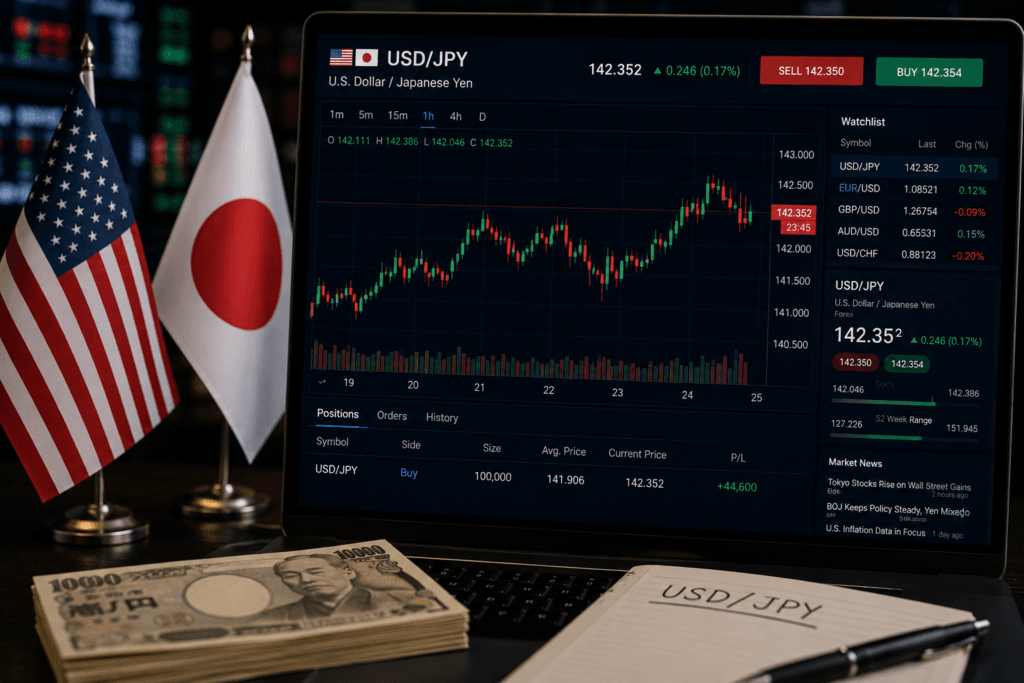
No major currency pair in 2026 has a more dramatic story than USD/JPY. While most forex pairs trade within ranges that drift gradually, USD/JPY has spent the year pressed right up against a number that triggers genuine fear in large institutional trading desks: 160.
That number isn’t arbitrary. It’s the level where Japanese authorities have historically stepped in to defend the yen through direct currency market intervention — and as of mid-June 2026, USD/JPY is trading right at that edge. According to FXStreet’s real-time data, USD/JPY trades marginally lower at around 160.14 at press time, keeping a bullish near-term bias as it holds above the 20-day exponential moving average at 159.69.
This is the most consequential macro tug-of-war in forex right now — and the forecast spread between major banks reflects genuine, deep uncertainty about how it resolves.
The Core Story: Two Central Banks Moving in Opposite Directions
According to BitMEX’s April 2026 USD/JPY deep-dive, the Bank of Japan is tightening while the Federal Reserve is easing — the rate gap between the two economies is shrinking for the first time in years, and that shift ripples through carry trades, corporate hedging flows, and speculative positioning.
This is the opposite dynamic from what drove USD/JPY higher for most of the past several years. When the Fed held rates high and the BOJ kept rates near zero, the rate differential made holding dollars far more attractive than holding yen — pushing USD/JPY consistently higher. Now both pieces of that equation are moving: the Fed is cutting, and the BOJ is hiking. The structural tailwind behind dollar strength against the yen is fading, even as the pair currently sits near multi-decade highs.
What the Bank of Japan Is Doing
The Bank of Japan has been gradually moving away from its decades-long ultra-loose monetary policy stance. According to FXStreet’s June 2026 coverage, USD/JPY finds marginal yen support from hawkish BoJ commentary and signals from the April meeting minutes that further rate hikes remain on the table.
This hawkish tilt is a genuine reversal of Japan’s historical monetary policy identity. For most of the past three decades, Japan was synonymous with near-zero or negative interest rates. A BOJ that’s actively signaling further hikes — even gradual ones — represents one of the most significant structural shifts in global currency markets this decade.
Learn Forex Easy’s 2026 BOJ analysis frames the stakes directly: if the Bank of Japan decides to raise interest rates or abandon its previous ultra-loose policy stance more aggressively, it could strengthen the yen significantly — though if the BOJ maintains its current gradual stance and US rates remain elevated, the pair could continue trading at high levels.
The Intervention Threshold: Why 160 Matters So Much
This is the number every USD/JPY trader has circled on their calendar in 2026.
According to BitMEX’s analysis, 160 is the battleground level for 2026 — USD/JPY has been consolidating just below it since late March, and multiple attempts to break above have stalled. The same analysis notes that market analysts monitor the USD/JPY chart closely for signs of intervention if the rate approaches the 160 threshold — referring to direct currency market intervention, where the Japanese Ministry of Finance instructs the Bank of Japan to buy yen and sell dollars to defend the currency from further weakening.
Japan has intervened in currency markets multiple times in recent years when USD/JPY approached similar levels. The mere risk of intervention changes trader behavior — large speculative positions become riskier to hold near 160 because a surprise intervention can move the pair sharply and instantly against an overextended position.
DailyForex’s June 2026 monthly analysis captures the standoff dynamic vividly: it is clear financial institutions and large players are willing to bet against the BOJ even as the central bank threatens interventions to hurt them — big players and small traders are watching what can be compared to an old fashioned cowboy movie, where the bad guy gets warned repeatedly to stop and doesn’t, until the person who warned them gets mad and takes action.
According to DailyForex’s specific near-term range, the speculative price range for USD/JPY is 156.450 to 160.850, with USD/JPY as of recent writing near the 159.300 level, incrementally reestablishing the higher realms of the currency pair after dynamic volatility in late April and early May.
Key Technical Levels for June 2026
Resistance Levels
| Level | Significance |
|---|---|
| 160.00 | Psychological battleground — BOJ intervention threshold |
| 160.850 | DailyForex speculative range ceiling |
| 162.00–164.00 | Open path if 160 clears decisively — J.P. Morgan target zone |
| 167.26 | CoinCodex 2026 year-end high projection |
| 180.61 | XS.com extreme upper bound (less likely scenario) |
Support Levels
| Level | Significance |
|---|---|
| 159.69 | 20-day EMA — current dynamic support, FXStreet |
| 156.450 | DailyForex speculative range floor |
| 153.80 | 200-day moving average — BitMEX’s key trend signal |
| 150.00 | Major psychological level — Scotiabank year-end target |
| 145.00 | Westpac’s bearish year-end target |
BitMEX’s technical breakdown is precise about why the 200-day moving average matters so much here: the 200-day moving average has been the best trend indicator for USD/JPY over the past three years — as of late April 2026, it sits near 153.80 with price trading well above at 159, and a decisive daily close below 153.80 would be the first technical signal that the yen bull case is accelerating.
What Major Banks Are Forecasting — And Why the Gap Is So Wide
This is where USD/JPY analysis gets genuinely interesting. The forecast dispersion among major banks for year-end 2026 is enormous — wider than almost any other major currency pair.
| Bank | Year-End 2026 Target | Direction |
|---|---|---|
| J.P. Morgan | 164.00 | Bullish (dollar strength) |
| ING | 153.00 | Bearish |
| Scotiabank | 150.00 | Bearish |
| Westpac | 145.00 | Most bearish |
| Goldman Sachs | “Two-way risk” — no directional call | Neutral/hedge |
| CoinCodex (model) | 167.26 | Bullish |
| LongForecast (model) | 160.00 average in June, gradual rise H2 | Mildly bullish |
That’s a roughly 19-yen spread between the most bullish (J.P. Morgan, 164) and most bearish (Westpac, 145) major bank forecasts. For context, that’s larger than the entire trading range USD/JPY covered through most of 2025. This dispersion reflects exactly how uncertain the Fed-BOJ policy paths are right now — banks fundamentally disagree on whether the Fed’s easing or the BOJ’s tightening will dominate the pair’s direction.
LiteFinance’s broader 2026 model-based forecast splits the difference: forecasts for 2026 suggest a range of approximately 154.08 to 180.61 yen, with more conservative estimates putting the range at 155.00 to 168.00 — analysts anticipate an upward trend for the currency pair in 2026 amid changes in regulators’ monetary policy, with the average price projected to be 158.94 in June, rising to 166.01 by mid-fall, and reaching a high of 167.26 by year-end.
The Fed’s Side of the Equation
It’s not just the BOJ driving this story — the Fed’s own policy path has genuine ambiguity baked in too.
According to FXStreet’s June 2026 coverage of the Fed’s Summary of Economic Projections, half of the FOMC members still expect at least one rate hike in 2026, despite recent economic disruptions linked to the conflict in Iran — a resilient US labor market and persistent underlying inflation continue to fuel monetary tightening pressures. This is the same hawkish dot plot dynamic that’s been weighing on gold and supporting dollar strength across multiple pairs in June 2026 — new Fed Chair Kevin Warsh, who took office in May 2026, has so far leaned more hawkish than markets initially expected from his appointment.
If the Fed ends up hiking rather than cutting through the rest of 2026 — a real possibility given that half the FOMC currently favors that path — it directly undercuts the bearish USD/JPY case that ING, Scotiabank, and Westpac are all building their forecasts around. The entire bearish thesis depends heavily on the Fed actually following through on rate cuts, which is genuinely uncertain given June’s hawkish signals.
Fiscal Stimulus: Japan’s Wildcard
Beyond monetary policy, there’s a domestic fiscal factor adding complexity to the yen outlook.
According to XS.com’s 2026 forecast analysis, “Sanaenomics” and a ¥21.3 trillion stimulus package might also influence the USD/JPY forecast for the next six months — this fiscal expansion is designed to support growth and combat the impact of rising living costs, with the interaction between fiscal stimulus and monetary tightening remaining a key theme for the yen forecast. Investors are watching whether this stimulus eventually strengthens domestic demand enough to give the BOJ more room to tighten policy further without damaging Japan’s economic recovery.
This is a genuinely two-sided factor: large-scale fiscal stimulus can be inflationary, which supports the case for BOJ tightening (yen-positive), but it can also weigh on the currency in the short term if markets interpret it as a sign of underlying economic weakness requiring government support (yen-negative).
What This Means for Trading Strategy
Given the scale of forecast uncertainty here, how should traders actually think about USD/JPY in the second half of 2026?
Goldman Sachs’ approach — hedging via short USD/JPY rather than taking an outright directional bet — reflects the genuinely two-sided nature of this market right now. DailyForex’s near-term tactical advice echoes this caution: looking for more moves higher should be done with limited targets, not exposing day traders to too much time lapse — because the Bank of Japan, like an old fashioned cowboy movie sheriff, is warning everyone to be careful, and small speculators may just want to watch from the sidelines to stay safe.
That’s a notably cautious take from a publication that normally provides directional trade ideas — and it reflects the genuine intervention risk sitting at the 160 level right now.
Bullish Scenario (Path Toward J.P. Morgan’s 164)
Conditions: Fed follows through on the half-FOMC hike bias rather than cutting. US labor data stays resilient. BOJ moves cautiously and gradually rather than aggressively. No intervention from Japanese authorities.
Technical confirmation: Sustained daily closes above 160.85, clearing the DailyForex speculative ceiling, opening the path toward 162–164.
Bearish Scenario (Path Toward 150 or Lower)
Conditions: Fed delivers actual rate cuts as originally projected before the hawkish June dot plot revision. BOJ accelerates tightening beyond gradual pace. Risk-off sentiment drives yen safe-haven demand.
Technical confirmation: Decisive daily close below the 200-day moving average at 153.80 — per BitMEX, this is the specific signal that would validate the yen bull case accelerating toward the 150 and eventually 145 targets that ING, Scotiabank, and Westpac are projecting.
What Traders Should Watch Through Summer 2026
| Event/Factor | Why It Matters |
|---|---|
| BOJ policy meetings | Any signal of accelerated tightening directly strengthens the yen |
| Fed July/September FOMC | Will clarify whether the hawkish June dot plot bias persists |
| 160.00–160.85 zone | The active intervention-risk ceiling — watch for MOF/BOJ commentary near this level |
| 153.80 (200-day MA) | The key bearish confirmation level per BitMEX’s model |
| US labor market data | Resilient data supports the bullish, higher-for-longer dollar case |
| Japan fiscal stimulus rollout | ¥21.3 trillion package effects on inflation and BOJ flexibility |
| Iran-related geopolitical developments | Active wildcard affecting broader dollar demand and risk sentiment |
The Bottom Line
USD/JPY in June 2026 sits at one of the most genuinely uncertain technical and fundamental crossroads in major forex. The pair is pressed right against the historically significant 160 intervention threshold, with a hawkish Fed and a cautiously tightening BOJ pulling in directions that, in theory, should be narrowing the rate differential that’s kept the dollar dominant against the yen for years.
But the forecast spread among major banks — from J.P. Morgan’s 164 to Westpac’s 145 — tells you everything about how unresolved this story actually is. The honest answer for where USD/JPY goes next depends almost entirely on two things that remain genuinely uncertain: whether the Fed actually follows through on the hawkish bias from its June dot plot, and whether the Bank of Japan accelerates its tightening pace or continues with its current gradual approach.
Until one of those two questions resolves more clearly, expect continued volatility around the 160 level — and genuine two-way risk for traders on either side of this pair.
FAQ
Q1: Why is 160 such an important level for USD/JPY? A1: The 160 level is widely watched as the threshold where the Bank of Japan and Japanese Ministry of Finance have historically intervened in currency markets to defend the yen from further weakening. USD/JPY has been consolidating just below 160 since late March 2026, with multiple attempts to break above stalling — partly due to genuine fear among large traders that a breakout could trigger direct intervention.
Q2: What is the USD/JPY forecast for the rest of 2026? A2: Major bank forecasts vary widely. J.P. Morgan projects 164 by year-end, citing persistent US yield advantages. ING forecasts 153, Scotiabank targets 150, and Westpac is most bearish at 145. Goldman Sachs has avoided a directional call, recommending hedged positioning instead. This roughly 19-yen forecast spread reflects genuine uncertainty about whether Fed policy or BOJ tightening will dominate the pair’s direction through the rest of 2026.
Q3: Why is the Bank of Japan raising interest rates in 2026? A3: The Bank of Japan has been gradually moving away from its decades-long ultra-loose monetary policy, with hawkish commentary and April 2026 meeting minutes signaling further rate hikes remain on the table. This reflects a structural shift away from Japan’s historical near-zero rate environment, aimed at addressing inflation and supporting the yen, which has weakened significantly against the dollar in recent years.
Q4: How does Federal Reserve policy affect USD/JPY? A4: The Fed and Bank of Japan are currently moving in opposite policy directions — the BOJ tightening while the Fed eases — which narrows the interest rate differential that has driven dollar strength against the yen. However, the Fed’s June 2026 Summary of Economic Projections showed half of FOMC members still expect at least one rate hike in 2026, introducing genuine uncertainty about whether the easing path that would weaken the dollar against the yen will actually continue.
Q5: What is the key technical level to watch for a USD/JPY trend reversal? A5: According to BitMEX’s technical analysis, the 200-day moving average — sitting near 153.80 as of mid-2026 — has been the most reliable trend indicator for USD/JPY over the past three years. A decisive daily close below this level would be the first technical signal that the yen bull case (a falling USD/JPY) is accelerating, opening the path toward the 150 and 145 targets projected by more bearish bank forecasts.
RISK DISCLAIMER
This article is for informational and educational purposes only and does not constitute investment advice, financial advice, or a recommendation to buy or sell any currency pair. Forex trading involves substantial risk of loss and is not suitable for all investors. Currency market interventions by central banks can cause sudden, sharp price movements. Past performance is not indicative of future results. Always conduct your own research and consider consulting a licensed financial advisor before making any trading or investment decisions.

Mohammad Javed is the founder and personal finance writer behind FinanceBeliever.com. He holds a Master of Commerce (MCom) degree with a specialization in finance and financial markets. Through years of personal experience studying credit systems, debt management, investment strategies, and how everyday financial decisions impact real households, he built Finance Believer to deliver straight, research-backed financial guidance to American readers. Every article he writes is sourced from authoritative data — including the Federal Reserve, the Consumer Financial Protection Bureau, and the Bureau of Labor Statistics. His work covers credit scores, loans, banking, insurance, investing, and personal budgeting — all written in plain English without the jargon.