
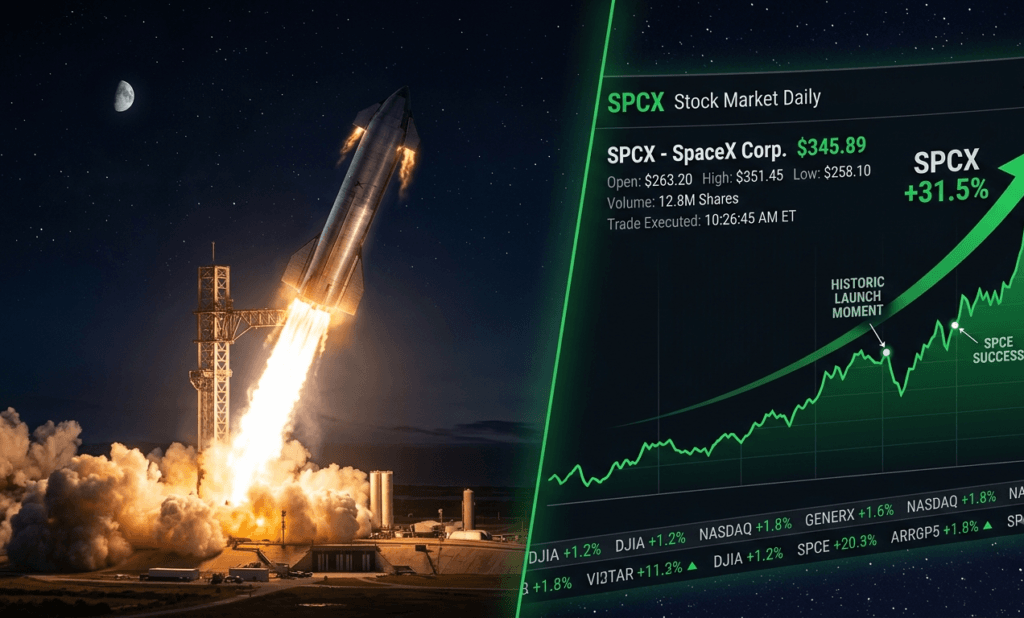
Something historic happened in the stock market this morning that affects millions of Americans who don’t even know it yet.
At the opening bell on July 7, 2026, SpaceX — officially Space Exploration Technologies Corp, trading as SPCX — became part of the Nasdaq-100 index. That might sound like inside baseball if you’re not a professional investor. But here’s why it matters to you directly: if you own a QQQ ETF, a QQQM ETF, or any Nasdaq-100 index fund in your 401(k) or brokerage account, you now own SpaceX stock. Automatically. Whether you chose to or not.
This is how index investing works — and today’s event is one of the most significant forced buying events in stock market history. Here’s everything you need to understand.
The Biggest IPO in History — A Quick Recap
SpaceX went public on June 12, 2026 — just 25 days ago. It raised $85.7 billion at $135 per share, making it the largest initial public offering in capital markets history. Within its first three trading days, the stock surged nearly 50%, briefly pushing SpaceX above Amazon and Microsoft in total market cap. Then it gave almost all of it back just as fast.
As of today, CNN BusinessSpaceX shares are up almost 20% from the IPO target price of $135 a share — but down 21% from their closing peak shortly after the IPO. That kind of volatility in three weeks tells you exactly what kind of stock this is going to be.
The company currently has a total market cap of more than $2 trillion — The Motley Foolmaking it one of the five largest publicly traded companies in the United States at birth.
Why SpaceX Joined the Index So Fast — And Why That’s Unusual
Here’s something that should make every index investor pay attention.
Nasdaq rewrote its own rules to get SpaceX in faster. Traditionally, the Nasdaq-100 required companies to have been publicly traded for at least three months before qualifying for inclusion. SpaceX joined after just 15 trading days.
ETF.comSpaceX blew past all of that under a new Nasdaq rule that took effect May 1, 2026: any company ranked in the top 40 by market cap at the time of its IPO can enter the Nasdaq-100 after just 15 trading days. Critics have called this rule change a grift that guarantees massive mechanical buy demand for mega-IPOs at premium valuations, with passive index investors absorbing the rebalancing cost.
That criticism is not unfounded. SpaceX is being added to the Nasdaq-100 while it is currently unprofitable. Vested FinanceSpaceX’s 2025 revenue was $18.7 billion, up 33% year-over-year — but the company posted a net loss of $4.9 billion, driven by Starship R&D costs. Starlink is the only profitable segment. The rest of the business is burning cash.
ETF.comPassive index investors are being asked to buy a company at 90x+ revenue with a Q1 GAAP loss, because the index rules now say so. The S&P 500’s decision to maintain its profitability requirement looks more considered in retrospect.
What This Means if You Own QQQ, QQQM, or Any Nasdaq-100 Fund
This is the part that directly affects the most Americans.
CNN BusinessThere are over 200 investment products with $800 billion in assets that track the Nasdaq-100. Funds that track the index have to buy SpaceX in order to continue mirroring its performance. That means every passive investor in those funds gets automatic SpaceX exposure starting today.
The Motley FoolThe Invesco QQQ ETF and its twin, the Invesco Nasdaq 100 ETF (QQQM), manage a combined $570 billion in assets. These funds are going to need to buy a significant amount of SpaceX stock in order to track the index properly. JPMorgan estimates that SpaceX’s inclusion in the Nasdaq-100 could result in $4.3 billion of buying. BNP Paribas puts the figure closer to $8 billion when you include all Nasdaq-100 trackers globally.
The Motley FoolSpaceX will likely have only about a 1% weighting in the Nasdaq-100 — so if you own $10,000 worth of QQQ, you now own roughly $100 worth of SpaceX. Not life-changing exposure, but it’s there whether you want it or not.
If you are a passive QQQ or QQQM investor: you don’t need to do anything. This is background noise for long-term index holders. The rebalancing happened automatically.
If you’re an active investor trying to time the inclusion: Yahoo FinanceSpaceX has already shown how fast the trade can turn. After becoming retail’s biggest IPO trade, the stock quickly surged 50% in its first three trading days before giving nearly all of it back over the following three days.
The Forced Buying Mechanics — And Why They Create Short-Term Volatility
Understanding what actually happens during an index inclusion event helps you make sense of why SpaceX’s stock will likely be unusually volatile over the next few weeks.
When a stock joins a major index, every fund that tracks that index has to buy it — not because they want to, but because their mandate requires them to mirror the index exactly. This creates what traders call “forced buying” — mechanical demand that has nothing to do with the company’s actual business prospects.
Yahoo FinanceWhen SpaceX goes in, funds tied to the index need to buy SpaceX and trim other holdings so the portfolio still matches the benchmark. That process is called rebalancing, and for SpaceX it could mean billions of dollars of forced buying.
But here’s the catch that most retail investors miss: this forced buying arrives just as insider lockup periods are about to start expiring.
ETF.comSpaceX’s public float today is only 3%–5% of total shares outstanding. Starting around Q2 earnings (expected mid-July to September 2026), a staggered lockup expiration schedule begins releasing insider and pre-IPO investor shares into the market. That means the first big passive buying wave (today) arrives just weeks before significant insider selling windows open. Forced buyers on one side, potential insider sellers on the other — that’s a recipe for continued volatility.
Yahoo FinanceThe next price test is the $172 to $180 zone, a potential ceiling based on several technical measures and price action over the last two weeks. If SpaceX can break above that range with volume, the momentum trade gets interesting again. If it stalls there, watch for a pullback as lockup shares start hitting the market.
What History Says About Stocks After Joining the Nasdaq-100
The Motley FoolDuring the last decade, 92 stocks were added to the Nasdaq-100. Those stocks returned an average of 10% during the six-month period post-inclusion and 18% during the 12-month period post-inclusion.
That sounds great on the surface. But the historical context matters a lot. The companies that performed best after inclusion were typically ones with already-established profitability, growing revenues, and reasonable valuations. SpaceX doesn’t fit that profile yet — it’s a pre-profit company trading at 90x+ revenue.
The Motley FoolThe anticipation of inclusion in a major index tends to amplify trading volume and expand valuation multiples as momentum traders and growth funds pile in ahead of the official rebalancing date. That pre-inclusion buying happened in late June and early July — which means much of the “inclusion pop” may already be priced in by the time index funds actually execute their buys today.
The more cautionary examples from recent history: Peloton joined the Nasdaq-100 at its peak in December 2020 and subsequently lost over 90% of its value. Zoom joined near its pandemic high and fell dramatically afterward. Index inclusion is not a buy signal — it’s a mechanical event.
Should You Buy SpaceX Stock Directly?
This is the question every retail investor is asking today. Here’s the honest answer.
The bull case: SpaceX is genuinely one of the most important companies on the planet. Starlink has 10 million+ subscribers and is the only profitable segment, but it’s growing fast. The satellite broadband market is enormous. Starship, if it achieves commercial viability, changes the economics of space access entirely. Elon Musk has defied skeptics before — repeatedly. A company that’s losing money today on R&D investment has done that before and emerged dominant. Amazon lost money for years. Tesla lost money for years.
The bear case: The Motley FoolSpaceX is 25% more expensive than Rocket Lab, currently the second most richly valued stock in the Nasdaq-100, with a price-to-sales multiple of 88. The company posted a $4.9 billion net loss in 2025. Elon Musk holds 85.1% voting control — meaning public shareholders have virtually no say in company direction. The lockup expiration schedule means significant insider selling pressure is coming. And the stock has already shown it can drop 21% from its high in weeks.
The Motley FoolInvestors evaluating SpaceX stock would be wise to focus on the company’s operational milestones and cash-flow trajectory rather than the temporary tailwind of index-driven capital inflows.
The practical takeaway: if you want SpaceX exposure, you already have it through QQQ or any Nasdaq-100 fund. Buying additional shares directly is a concentrated bet on a pre-profit company at an extreme valuation during a period of known selling pressure from lockup expirations. That’s not a bet most long-term investors should be sizing up aggressively right now.
What About the Broader Market Right Now?
SpaceX’s inclusion is the headline, but the broader market context matters for anyone making investment decisions this week.
CNBCThe S&P 500 gained 0.72% on Monday to end at 7,537.43, while the Nasdaq Composite advanced 1.12% to 26,121.16. The Dow Jones Industrial Average climbed 155.84 points for a record close of 53,055.91.
But today — July 7 — the picture is more mixed. Yahoo FinanceUS stock futures pointed higher this morning with E-mini S&P 500 contracts up about 0.4% and Nasdaq-100 futures ahead close to 1%, as investors digest softer US jobs data, with June payrolls at 57,000. That’s a weak jobs number — which markets are reading as potentially softening the Fed’s hawkish stance.
The Fed’s position matters enormously right now. Vested FinanceFed Chair Kevin Warsh’s debut FOMC meeting removed the easing bias from the Fed’s statement and formally reset market expectations from cuts to possible hikes by year-end. That’s a major shift that’s been quietly pressuring rate-sensitive stocks all month.
FortuneBank of America reaffirmed their year-end price target of 7,100 for the S&P 500, representing a 5% drop from current levels, warning that “speculation is hitting extreme levels as high multiple stocks have gapped up demonstrably.” Meanwhile, JPMorgan raised their target to 7,800, and Yardeni Research pushed their target all the way to 8,250. The range of professional opinion on where the market goes from here is unusually wide — which itself is a signal of elevated uncertainty.
If you’re thinking about your overall investment strategy in this environment, our breakdown of Roth IRA vs. 401(k) — which one to use in 2026 is worth revisiting. The rate environment and potential market volatility ahead make the tax treatment of your accounts more important than usual.
And for anyone whose 401(k) exposure to Nasdaq-100 funds has them thinking about diversification, understanding how the EUR/USD currency pair reflects global economic shifts gives useful context for how international dynamics are affecting US markets right now.
Key Numbers to Watch This Week
| Metric | Current Level | What to Watch |
|---|---|---|
| SPCX Price | ~$162 (down from $225 peak) | $172–$180 resistance zone |
| S&P 500 | 7,537 | 7,100 (BofA target) vs 7,800 (JPM target) |
| Nasdaq-100 | 26,121 | SpaceX inclusion impact today |
| Dow Jones | 53,055 (record) | Holding above 53,000 |
| Fed Funds Rate | 3.50–3.75% | Any hike signal would hit growth stocks hard |
| June Jobs Report | 57,000 payrolls | Softer than expected — dovish signal |
Frequently Asked Questions
Does SpaceX joining the Nasdaq-100 mean I automatically own it? If you own any fund that tracks the Nasdaq-100 — including QQQ, QQQM, TQQQ, or a Nasdaq index fund in your 401(k) — yes. You now own approximately 0.5%–1% worth of SpaceX in your fund position. On $10,000 of QQQ, that’s roughly $50–$100 worth of SpaceX exposure. No action is required on your part.
Why did SpaceX join so quickly — only 15 days after its IPO? Nasdaq changed its rules in May 2026 specifically to allow mega-IPOs ranked in the top 40 by market cap to join the index after just 15 trading days instead of waiting months. SpaceX qualified easily. Critics say this rule benefits large IPOs at the expense of passive investors who are forced to buy at potentially inflated prices.
How much forced buying does SpaceX’s inclusion trigger? JPMorgan estimates $4.3 billion in forced buying from Nasdaq-100 trackers alone. BNP Paribas puts the total higher — potentially up to $27 billion when including all Russell index trackers and other benchmarks that added SpaceX around the same time.
Is SpaceX profitable? Not overall. SpaceX posted a $4.9 billion net loss in 2025, largely due to Starship R&D costs. Starlink — its satellite internet business with over 10 million subscribers — is the only profitable segment. The company is growing revenue fast (33% YoY) but is not yet GAAP profitable.
Should I buy SpaceX stock directly today? That’s a personal decision, but understand what you’re getting: a pre-profit company trading at 90x+ revenue during a period when insider lockup expirations are about to create significant selling pressure. The index inclusion buying wave may already be priced in. Long-term believers in SpaceX’s mission have a real bull case — but valuation and near-term technicals are challenging right now.
This article is for informational and educational purposes only and does not constitute financial or investment advice. Past market performance is not indicative of future results. Always conduct your own research and consult a qualified financial advisor before making investment decisions. Risk disclaimer: Stock market investments involve risk, including the possible loss of principal.

Mohammad Javed is the founder and personal finance writer behind FinanceBeliever.com. He holds a Master of Commerce (MCom) degree with a specialization in finance and financial markets. Through years of personal experience studying credit systems, debt management, investment strategies, and how everyday financial decisions impact real households, he built Finance Believer to deliver straight, research-backed financial guidance to American readers. Every article he writes is sourced from authoritative data — including the Federal Reserve, the Consumer Financial Protection Bureau, and the Bureau of Labor Statistics. His work covers credit scores, loans, banking, insurance, investing, and personal budgeting — all written in plain English without the jargon.