
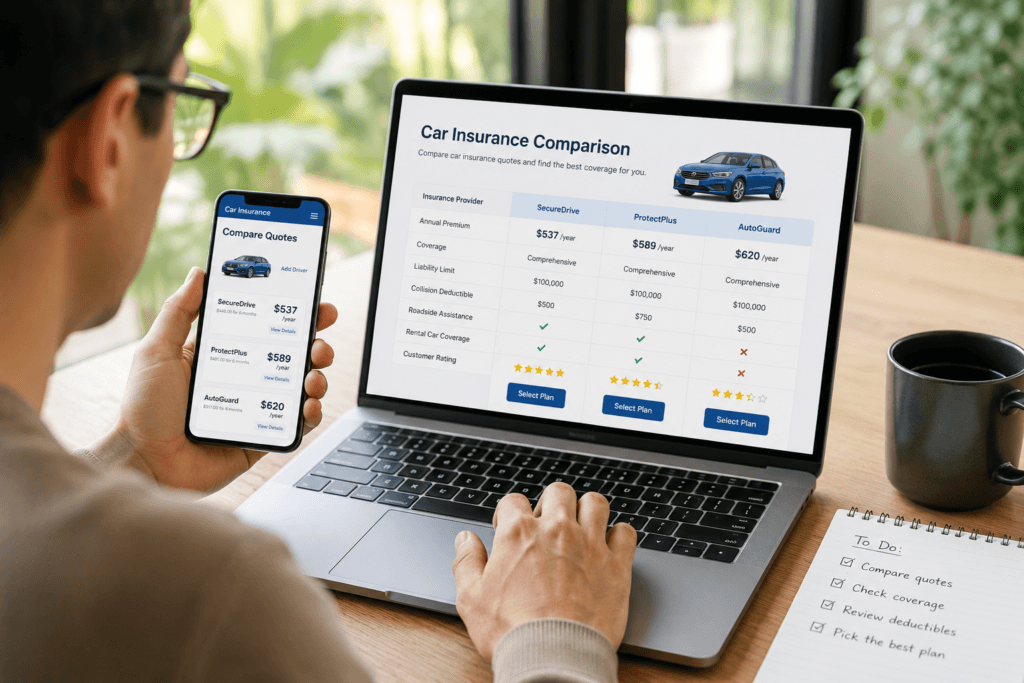
Here’s something most American drivers have never done — and it’s costing them hundreds of dollars every single year.
The national average car insurance rate hit $1,707 per year in 2026, according to Insurify’s May 2026 rate analysis. And prices are rising in 35 states this year, with some states seeing double-digit percentage increases. Georgia, Washington, and Washington D.C. are on track for the highest increases of 2026.
But here’s what changes everything: according to MoneyGeek’s analysis of 2.4 million car insurance quotes, the same driver with the same car and the same coverage can receive quotes ranging from $600 to over $2,000 per year from different insurers. Comparing quotes from at least three companies saves drivers an average of $709 per year. Some drivers find differences of more than $8,500 annually for identical coverage.
The math is simple: spending 15 minutes comparing car insurance quotes online can save you $709 this year, and every year after that. This guide shows you exactly how to do it.
Why Car Insurance Prices Vary So Dramatically
Before getting into the comparison process, it helps to understand why the same driver gets such wildly different quotes from different companies.
Every insurance company uses its own proprietary algorithm to calculate risk. They weigh factors like your driving history, credit score, age, location, vehicle type, and annual mileage — but they weight each factor differently. Progressive might penalize a minor speeding ticket far less than Allstate. State Farm might be far more lenient with a gap in coverage history than GEICO.
As Insurance.com’s May 2026 comparison guide explains, no single national carrier sweeps the map with the lowest rates. State Farm offers the lowest rates in 18 states. GEICO leads in 16 states. Your cheapest option depends entirely on your specific profile and your specific state — which is why comparing is non-negotiable.
The bottom line: loyalty to one insurance company without shopping around is one of the most common ways Americans overpay for coverage they could get cheaper elsewhere.
Step 1: Gather Your Information Before You Start
Comparing quotes efficiently requires having the right information ready. Pulling quotes without accurate information produces inaccurate quotes — and the discrepancy between your quoted rate and your actual premium is one of the most common insurance frustrations.
What you need:
Vehicle information:
- Make, model, year, and trim level of every vehicle you’re insuring
- Vehicle Identification Number (VIN) — found on your dashboard or registration
- Current mileage and estimated annual mileage
- Whether the vehicle is owned outright, financed, or leased
Driver information for every driver on the policy:
- Full legal name and date of birth
- Driver’s license number and state
- Driving history for the past 3–5 years (accidents, tickets, DUIs)
- Whether you own or rent your home (affects bundling discounts)
Current policy information:
- Your current insurer and policy number
- Current coverage limits and deductibles
- Date your current policy expires
Having all of this ready before you start means quotes are accurate and the comparison is apples-to-apples.
Step 2: Decide What Coverage You Actually Need
Comparing quotes only works when you’re comparing the same coverage across all companies. Getting a lower quote because you accidentally reduced your coverage isn’t savings — it’s a gap in protection.
State minimum liability — Every state requires at least liability insurance. Minimums vary significantly. In many states, the minimum is dangerously low — $25,000/$50,000/$25,000 in California, for example — and would leave you personally liable for damages above those limits after a serious accident.
100/300/100 liability — The most commonly recommended liability limit for American drivers in 2026. This means $100,000 per person, $300,000 per accident, and $100,000 in property damage. Meaningful protection at a reasonable cost increase over state minimums.
Comprehensive and collision — Required by lenders if your vehicle is financed or leased. Covers damage to your vehicle from accidents, theft, vandalism, weather events, and other incidents. For vehicles worth less than $4,000, the math often favors dropping collision and carrying only liability.
Uninsured/underinsured motorist — Covers you when you’re hit by a driver who has no insurance or insufficient insurance. Given that an estimated 13% of American drivers are uninsured, this is coverage worth keeping.
Deductible — The amount you pay out of pocket before insurance kicks in on a claim. A $1,000 deductible produces a lower premium than a $500 deductible. Choose the highest deductible you could comfortably pay in an emergency without financial strain.
Step 3: Use Multiple Comparison Tools
The most efficient way to compare car insurance quotes online in 2026 is through comparison platforms — tools that pull quotes from dozens of insurers simultaneously, saving you from visiting 10 separate insurer websites.
The best comparison platforms in May 2026:
Insurify — Insurify’s comparison tool analyzes quotes from 500+ insurance companies using real-time data. Their algorithm has helped customers compare more than 85 million quotes, and they estimate savings of up to $1,100 per year for drivers who switch through their platform. Insurify does not sell your personal information to data brokers.
The Zebra — The Zebra partners with over 100 insurance companies and has helped customers compare more than 74 million quotes. Their interface is particularly strong for side-by-side rate comparisons across identical coverage levels.
Compare.com — Licensed in all 50 states, Compare.com analyzes more than 90 million real-time quotes. Country Financial appears as the cheapest overall option in their dataset, with average liability rates starting at $44 per month. Their platform generates commissions only when you buy — not from selling your data.
MoneyGeek — MoneyGeek’s auto insurance analysis weighs affordability (50%), customer experience (30%), and coverage options (20%) to produce balanced recommendations. Their dataset of 2.4 million quotes is one of the most comprehensive available.
Important: Use at least two of these platforms, then get one direct quote from your top choice insurer. This three-source approach consistently produces the most accurate rate comparison.
Step 4: Compare Quotes Side by Side on the Same Coverage
Once you have quotes, the comparison process requires discipline. Insurance companies present their quotes differently, and it’s easy to accidentally compare different coverage levels.
For every quote, verify:
| Element | What to Check |
|---|---|
| Liability limits | Identical across all quotes |
| Deductible amount | Same deductible on all comp/collision quotes |
| Uninsured motorist | Included or excluded in all quotes |
| Comprehensive | Same or excluded in all quotes |
| Policy term | 6-month vs 12-month affects the annual comparison |
The rate variation is real and significant. As MoneyGeek’s data confirms, Progressive might quote you $52 a month for the same coverage Nationwide prices at $77. That $25-per-month difference is $300 per year for literally identical protection.
The 2026 Car Insurance Rate Landscape — What You’re Competing Against
Knowing the national and state averages helps you evaluate whether a quote is genuinely competitive or whether to keep shopping.
| Driver Profile | National Average Annual Rate |
|---|---|
| Good driver, good credit | ~$1,400–$1,600/year |
| Good driver, poor credit | ~$2,200–$2,800/year |
| One at-fault accident | ~$2,100–$2,600/year |
| DUI on record | ~$3,500–$4,500/year |
| Teen driver added | +$1,500–$3,000/year |
The national average annual car insurance rate is $1,707. State averages range from less than $1,000 per year to more than $4,000. Washington, D.C., had the highest average by the end of 2025, at $4,017 annually. New Hampshire had the nation’s lowest annual rate of $956.
If your current rate is significantly above the average for your profile and state, that’s a strong signal to shop aggressively.
Step 5: Maximize Every Available Discount
Discounts are one of the most underutilized tools in car insurance savings. Most drivers qualify for multiple discounts they’ve never asked about.
Multi-policy discount (bundling) — Insuring your car and home with the same company typically saves 10% to 25% on both policies. If you’re a renter, bundling auto with renters insurance produces similar savings. This is consistently the single largest discount most American drivers can access.
Safe driver discount — A clean driving record for 3 to 5 years earns meaningful discounts with virtually every major insurer. State Farm’s Steer Clear program and GEICO’s DriveEasy app both reward verified safe driving with discounts of 5% to 30%.
Low mileage discount — If you drive less than 7,500 to 10,000 miles per year — working from home, using public transit, or living close to work — you likely qualify for a low-mileage discount of 10% to 30%. Always disclose accurate mileage; misrepresentation is grounds for policy cancellation.
Good student discount — Full-time students under 25 with a B average or above typically qualify for a 5% to 15% discount. This discount often gets overlooked when parents add young drivers to their policy.
Pay-in-full discount — Paying your annual premium upfront rather than monthly typically saves 5% to 10%. On a $1,500 annual premium, that’s $75 to $150 saved simply by paying differently.
Paperless and autopay discount — Most insurers offer small discounts (2% to 5%) for enrolling in paperless billing and automatic payment. Minor savings individually, but worth enabling on every account.
Vehicle safety features — Anti-lock brakes, airbags, anti-theft systems, and advanced driver assistance features (lane departure warning, automatic emergency braking) all qualify for discounts with most major insurers.
The Companies With the Lowest Rates in 2026
While the cheapest company for YOUR specific profile depends on your state and driving history, here’s what the data shows nationally:
State Farm — Offers the lowest rates in 18 states, according to MoneyGeek’s 2026 analysis. Particularly strong for drivers with clean records and good credit. Top-rated for customer service with one of the lowest complaint ratios among major insurers.
GEICO — Leads in 16 states on price and is particularly competitive for military members, federal employees, and drivers with multiple vehicles. Their digital-first model keeps overhead low and passes savings to customers.
Country Financial — Country Financial has the cheapest overall car insurance according to Compare.com’s analysis of more than 90 million real-time quotes, with average liability rates starting at just $44 per month. Less nationally prominent but worth including in your comparison.
Progressive — Most competitive for high-risk drivers and those with one or more accidents on record. Their Snapshot program uses telematics to reward safe driving regardless of history.
Auto-Owners — Consistently low rates but only available through independent agents in 26 states. If available in your state, worth getting a quote.
Step 6: Check the Company’s Financial Strength and Claims Reputation
Price is the starting point, not the finish line. A company that quotes you $200 less per year but takes 6 months to process a claim or disputes legitimate payouts isn’t a good deal.
Before choosing any insurer, check:
AM Best financial strength rating — A rating of A or higher indicates the company has the financial stability to pay claims reliably. Avoid any insurer rated below B+.
NAIC complaint ratio — The National Association of Insurance Commissioners publishes complaint ratios for every licensed insurer. A ratio below 1.0 means fewer complaints than average for a company of that size.
J.D. Power claims satisfaction score — J.D. Power surveys thousands of policyholders annually about their claims experience. A score in the top third of rankings indicates a smoother claims process.
Don’t choose an insurer that fails on any of these checks just because their rate is marginally lower. The savings disappear quickly if you face a difficult claim.
Step 7: Switch Strategically — Don’t Create a Coverage Gap
Once you’ve found a better rate, switching is straightforward — but timing matters.
Don’t cancel your current policy before the new one is active. A lapse in coverage — even for one day — can be used by future insurers to raise your rates. Cancel your old policy only after your new policy’s start date is confirmed in writing.
Check for cancellation fees. Some insurers charge a short-rate cancellation fee for canceling mid-term. Calculate whether the fee erases the savings from switching.
Request a refund of unused premium. If you’ve paid your current policy upfront and you cancel mid-term, you’re entitled to a pro-rated refund for the unused period.
Notify your lender. If your vehicle is financed, your lender requires continuous comprehensive and collision coverage. Notify them immediately when you switch insurers to maintain compliance with your loan agreement.
How Often Should You Compare Car Insurance Quotes?
At minimum: Once per year, at renewal time. Rates change regularly and your circumstances change — a birthday, a marriage, a new home, a new vehicle, a cleared accident from your record — all of these can meaningfully shift what you qualify for.
Also consider comparing after:
- A major life event (marriage, divorce, new home purchase)
- Your record clears a violation (typically 3–5 years after the incident)
- You pay off your vehicle (you may want to drop collision)
- Your teenager turns 25 (young driver premium typically drops significantly)
- You move to a new ZIP code or state
As Insurance.com’s 2026 guide advises, events in your life like moving or marriage will greatly affect what you pay — so using up-to-date information to request new quotes after major changes is worth the 15-minute investment.
If you’re also looking at your overall insurance coverage picture, our guide on does renters insurance cover car break-ins explains how your renters or homeowners policy works alongside your auto coverage — so you’re not paying for overlapping protection.
Explore more article : Best Term Life Insurance for 55-Year-Olds in 2026 (Real Rates Compared)
Frequently Asked Questions
How much can I save by comparing car insurance quotes? Drivers who compare quotes from at least three companies save an average of $709 per year, according to MoneyGeek’s analysis of 2.4 million quotes. Some drivers find differences of more than $8,500 annually for identical coverage. The national average rate is $1,707 per year, but the same driver can receive quotes ranging from $600 to over $2,000 from different insurers.
Which car insurance comparison site is best in 2026? Insurify, The Zebra, Compare.com, and MoneyGeek are the top comparison platforms in 2026. Using at least two platforms plus one direct quote from your preferred insurer gives you the most accurate comparison. No single platform covers every insurer, so using multiple sources catches options you might otherwise miss.
Which car insurance company is cheapest in 2026? No single company is cheapest for every driver. State Farm offers the lowest rates in 18 states, GEICO leads in 16 states, and Country Financial ranks as cheapest overall in Compare.com’s national dataset at $44 per month for liability. Your cheapest option depends on your driving history, credit score, location, vehicle, and coverage needs.
How long does it take to compare car insurance quotes? Using an online comparison platform, you can receive quotes from multiple insurers in 10 to 15 minutes with your information ready. Purchasing a new policy and having coverage active can happen within the same session. You can have a new car insurance policy within minutes of receiving a quote from most major insurers.
Does comparing car insurance quotes affect my credit score? No. Car insurance quote comparisons use a soft credit inquiry, which does not affect your credit score. Only applying for credit products like loans and credit cards uses a hard inquiry. You can compare as many insurance quotes as you want without any impact to your credit.
This article is for informational purposes only. Car insurance rates vary significantly by state, driver profile, vehicle, and coverage selection. Always verify current rates directly with insurers before making coverage decisions.

Mohammad Javed is the founder and personal finance writer behind FinanceBeliever.com. He holds a Master of Commerce (MCom) degree with a specialization in finance and financial markets. Through years of personal experience studying credit systems, debt management, investment strategies, and how everyday financial decisions impact real households, he built Finance Believer to deliver straight, research-backed financial guidance to American readers. Every article he writes is sourced from authoritative data — including the Federal Reserve, the Consumer Financial Protection Bureau, and the Bureau of Labor Statistics. His work covers credit scores, loans, banking, insurance, investing, and personal budgeting — all written in plain English without the jargon.