
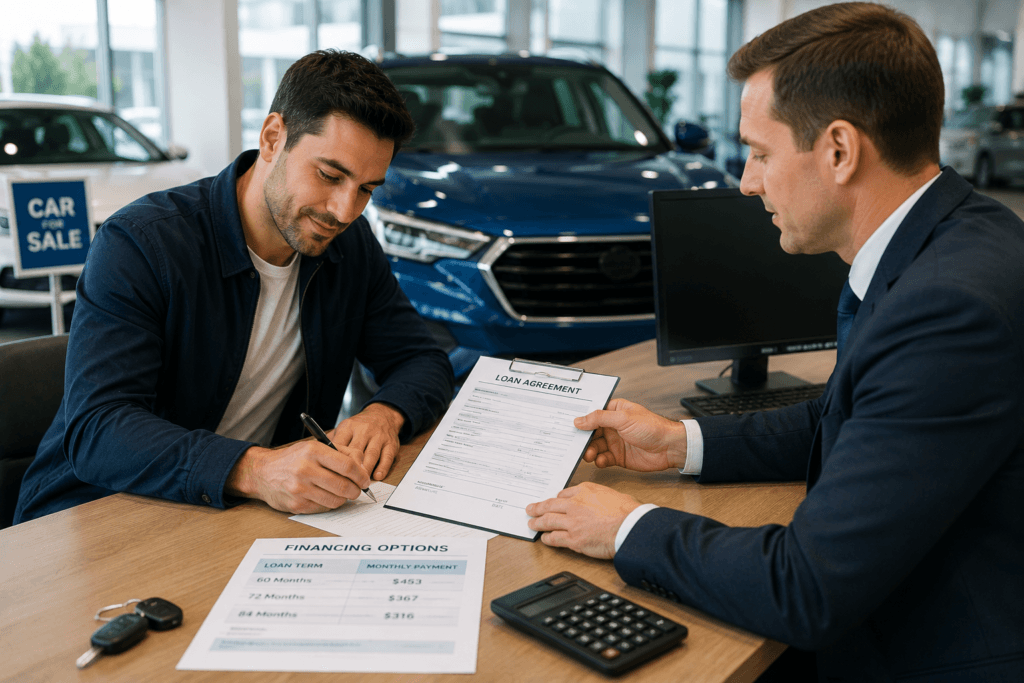
Here’s the thing nobody at the dealership tells you: “good APR” isn’t one number. It’s different for every person sitting across from that finance manager.
A 7% APR might be a great deal for someone with a 650 credit score. That same 7% would be a rip-off for someone with a 780. And the dealer knows exactly which one you are before you sit down — because they pulled your credit the moment you handed them your driver’s license.
So let’s flip the script. Before you walk into any dealership, before you talk to any finance office, here’s exactly what a good APR looks like for your credit score in 2026 — and what you can do to make sure you’re getting it.
What the Average Car Loan APR Looks Like Right Now
According to Bankrate’s weekly auto loan survey updated June 3, 2026, the current average APR for a 60-month new car loan sits at 6.98%. For used car loans, the average runs higher — around 11.87% — because lenders price in the added risk of financing a depreciating asset with less collateral value.
Those are averages across all borrowers. Your actual rate will land somewhere very different depending on your credit score, the loan term you choose, whether you’re buying new or used, and where you get the loan from.
According to PrimeRates’ 2026 auto loan analysis, the Fed funds rate currently sits at 3.50% to 3.75%, and Bankrate projects new car loan rates could fall to about 6.40% by end of 2026 if the Fed cuts rates further. That means right now is actually a decent time to lock in a rate — and shopping aggressively could put you below the average by a meaningful margin.
Good APR by Credit Score — The Full Breakdown
This is the table you actually need. According to LendEDU’s May 2026 auto loan rate analysis, here’s what borrowers at each credit tier can realistically expect:
| Credit Score Tier | Score Range | Avg New Car APR | Avg Used Car APR | Is This “Good”? |
|---|---|---|---|---|
| Super Prime | 781–850 | 5.18%–5.25% | 6.82%–7.13% | ✅ Excellent |
| Prime | 661–780 | 6.70%–7.01% | 9.06%–9.50% | ✅ Good |
| Near Prime | 601–660 | 9.50%–11.00% | 13.00%–14.50% | 🟡 Fair |
| Subprime | 501–600 | 13.18%–15.00% | 18.86%–21.00% | 🔴 High — shop hard |
| Deep Subprime | Below 500 | 15.00%–21.00%+ | 21.00%–28.55%+ | 🔴 Very high |
Here’s how to read that table: if your credit score is 720 and you’re getting quoted 9%, that’s not a good rate — that’s a prime borrower being charged near-prime rates. That’s worth pushing back on.
According to LendingTree’s June 2026 auto data, average car loan offers on their marketplace range from 6.81% to 23.82% APR, and comparing offers from several lenders can save the average borrower $2,346 over the life of the loan. That number alone should tell you how much it’s worth to shop around.
New Car vs. Used Car — Why Rates Are Different
You’ll notice used car rates are consistently 2% to 5% higher than new car rates. That’s not random.
Lenders price auto loans based on the risk of the collateral — meaning how much they can recover if you stop paying and they have to repossess the vehicle. A new car has a known value and manufacturer warranty. A used car depreciates faster, has unknown maintenance history, and is worth less the moment something goes wrong.
According to Broadview Federal Credit Union’s 2026 used car guide, used car loan rates range from 5.49% to 14.99% APR depending on credit score, vehicle age, and loan term — and cars older than five years or with high mileage face additional rate bumps of 0.5% to 2%.
Practical takeaway: if you’re buying a used car, compare it against newer certified pre-owned options where rates are sometimes closer to new car financing. The difference in monthly payment might be smaller than you think once you account for the rate gap.
How Loan Term Affects Your APR
Most people focus on monthly payment. Lenders love this — because it lets them stretch your term, charge you more in total interest, and have you walk away feeling like you got a deal.
Here’s how the math actually works on a $35,000 car loan at 7% APR:
| Loan Term | Monthly Payment | Total Interest Paid |
|---|---|---|
| 36 months | $1,081 | $2,916 |
| 48 months | $838 | $4,224 |
| 60 months | $693 | $5,580 |
| 72 months | $595 | $7,840 |
| 84 months | $527 | $10,268 |
The 84-month loan has a monthly payment $554 lower than the 36-month loan. It also costs you $7,352 more in total interest. That’s real money — and it’s why dealerships push long terms so aggressively.
A good APR paired with a shorter term almost always beats a slightly lower APR on a longer term. Run the total interest calculation before you decide.
Where You Get the Loan Matters as Much as Your Credit Score
The same borrower with the same credit score can get very different rates depending on where they apply. Here’s the honest hierarchy:
Credit Unions — Usually Your Best Bet
Credit unions are nonprofit and member-owned. They don’t have shareholders demanding maximum profit margins on every loan. According to US News Cars’ June 2026 auto loan analysis, borrowers with super prime credit saw average new car rates as low as 4.66% from credit bureaus in Q4 2025 — rates that banks and dealers rarely match. If you’re a member of a credit union, check their auto loan rates before you go anywhere else. If you’re not, many federal credit unions let you join online in minutes.
Banks and Online Lenders — Shop and Compare
Major banks like Chase, Bank of America, and Capital One offer pre-approval before you visit a dealership — which is exactly how you want to approach this. Get pre-approved first. Then the dealer’s financing offer has to beat your existing approval, not the other way around.
Dealership Financing — Convenient but Often Expensive
Dealerships make money on financing. The finance manager is not there to get you the best rate — they’re there to maximize the dealership’s profit from the transaction. The rate they quote you is often marked up from the actual lender rate they secured, and the markup goes straight into dealership revenue.
That doesn’t mean dealer financing is always bad. Sometimes dealers have manufacturer incentives — 0% APR promotions on certain models — that genuinely beat the market. But you’ll only know if you have a competing offer in hand first.
5 Things You Can Do Right Now to Get a Lower APR
1. Get Pre-Approved Before You Shop
This is the single most impactful thing most car buyers never do. Getting pre-approved at your bank or credit union before visiting a dealership gives you a real number to compare against — and puts you in a negotiating position instead of a dependent one.
Upstart’s 2026 car loan guide makes the point clearly: you can get a rough estimate of your APR based on your credit score before you even apply — and knowing your credit tier going in lets you recognize whether you’re being offered a fair rate or a marked-up one.
2. Shop Multiple Lenders in a Short Window
Each full loan application triggers a hard inquiry on your credit report. The good news: according to PrimeRates, if you apply to multiple lenders within a 14 to 45 day window, the credit bureaus treat all auto loan inquiries during that period as a single hard pull. Shop aggressively — apply to your credit union, your bank, and one or two online lenders — without worrying about multiple score hits.
3. Negotiate the Vehicle Price Separately From the Financing
This is where a lot of buyers get confused. The monthly payment is not the deal — the purchase price and the APR are two separate negotiations. A dealer can give you a “low” monthly payment by extending your term while keeping both the purchase price and the rate high.
Agree on the vehicle price first. Then introduce your pre-approved financing. Then let them try to beat it.
4. Consider a Larger Down Payment
A larger down payment reduces the loan amount, which reduces the lender’s risk, which can translate to a lower offered rate. It also reduces the total interest you pay regardless of rate. If you’re sitting on savings specifically earmarked for a car purchase, putting 15% to 20% down rather than the minimum makes a meaningful difference in both your rate and your total cost.
5. Set Up Autopay
Many lenders offer a 0.25% APR discount for setting up automatic payments from your bank account. It’s a small number on paper, but on a $35,000 loan over 60 months, a 0.25% reduction saves roughly $230. Takes two minutes to set up. Always worth doing.
When to Walk Away From a Rate
Knowing what a bad rate looks like is just as important as knowing what a good one looks like.
Walk away — or negotiate hard — if:
- You have a 700+ credit score and you’re being quoted above 8% on a new car
- You have a 750+ credit score and the dealer won’t match your credit union pre-approval
- The finance office is focused entirely on monthly payment without discussing APR or total loan cost
- You’re being offered an 84-month term to bring the payment “down to your range”
- The rate includes significant markup that the finance manager is vague about explaining
You are not obligated to finance through the dealership. Walking away and returning with your own financing is always an option — and the knowledge that you’ll do exactly that is often what gets the dealer’s finance office to sharpen their pencil.
What If Your Rate Feels Too High After the Fact?
Signed a loan you now regret? You’re not necessarily stuck.
If your credit score has improved since you got the original loan, or if you got the loan through a dealership at a marked-up rate, refinancing may be worth exploring. Our complete breakdown of how to refinance a car loan with bad credit in 2026 covers every step of the process — including which lenders work with subprime borrowers, how to calculate whether refinancing actually saves you money, and what to watch out for when comparing refinance offers.
And if the bigger picture is that you’re carrying multiple high-interest debts alongside a car loan, our guide on the best debt consolidation loans of 2026 walks through how combining balances can lower your overall monthly payment load and improve your debt-to-income ratio — which directly affects what rate you’ll qualify for next time you need to borrow.
The Bottom Line
A good APR for a car loan in 2026 is one that’s at or below the average for your credit tier — not the average for all borrowers combined.
If you have excellent credit: anything above 6% on a new car loan deserves a second look elsewhere. If you have fair credit: getting below 12% on a used car is a win worth working for. If you have subprime credit: your goal is to find a lender who’ll approve you at a rate you can actually pay, then refinance as soon as your credit improves.
The number that matters most isn’t your monthly payment — it’s your total interest paid over the life of the loan. Run that calculation before you sign anything.
FAQ
Q1: What is the average APR for a car loan in 2026? A1: According to Bankrate’s June 2026 weekly survey, the average APR for a 60-month new car loan is 6.98%. Used car loan rates average around 11.87% for all borrowers. Rates vary significantly by credit score — super prime borrowers (781–850) see rates as low as 5.18%, while subprime borrowers (501–600) average around 13.18% to 18.86% depending on vehicle type.
Q2: What credit score do I need to get a good car loan rate in 2026? A2: A score of 661 or above puts you in the prime tier, where average new car APRs run 6.70% to 7.01%. A score of 781 or above qualifies you for super prime rates starting around 5.18%. Scores below 600 push you into subprime territory where rates typically start at 13% and climb sharply.
Q3: Is 7% a good APR for a car loan? A3: It depends on your credit score. For a prime borrower (661–780), 7% is in line with current market averages and generally acceptable. For a super prime borrower (781+), 7% is above average and worth shopping for a better rate. For a near-prime borrower (601–660), 7% would actually be below average — meaning you may have found a good deal or should double-check what you qualified for.
Q4: Should I finance through the dealership or get my own loan? A4: Get pre-approved through your bank or credit union first, then compare that rate to what the dealership offers. Dealerships sometimes have manufacturer incentive rates that beat the market — but they also mark up rates for profit. Having your own pre-approval in hand puts you in a position to compare rather than depend on whatever the finance office quotes you.
Q5: How much can a better APR actually save me on a car loan? A5: Significantly. On a $35,000 car loan over 60 months, the difference between 7% APR and 11% APR is roughly $73 per month — or about $4,380 over the life of the loan. According to LendingTree, comparing offers from multiple lenders saves the average borrower $2,346 on their auto loan. That’s real money for spending 20 minutes shopping rates before you sign.
DISCLAIMER
Auto loan rates change frequently. The rates in this article are based on data available as of June 2026 from Bankrate, LendingTree, LendEDU, and other published sources. Your actual rate will depend on your individual credit profile, lender, loan term, and vehicle type. Always compare multiple lenders before accepting any auto loan offer.

Mohammad Javed is the founder and personal finance writer behind FinanceBeliever.com. He holds a Master of Commerce (MCom) degree with a specialization in finance and financial markets. Through years of personal experience studying credit systems, debt management, investment strategies, and how everyday financial decisions impact real households, he built Finance Believer to deliver straight, research-backed financial guidance to American readers. Every article he writes is sourced from authoritative data — including the Federal Reserve, the Consumer Financial Protection Bureau, and the Bureau of Labor Statistics. His work covers credit scores, loans, banking, insurance, investing, and personal budgeting — all written in plain English without the jargon.