
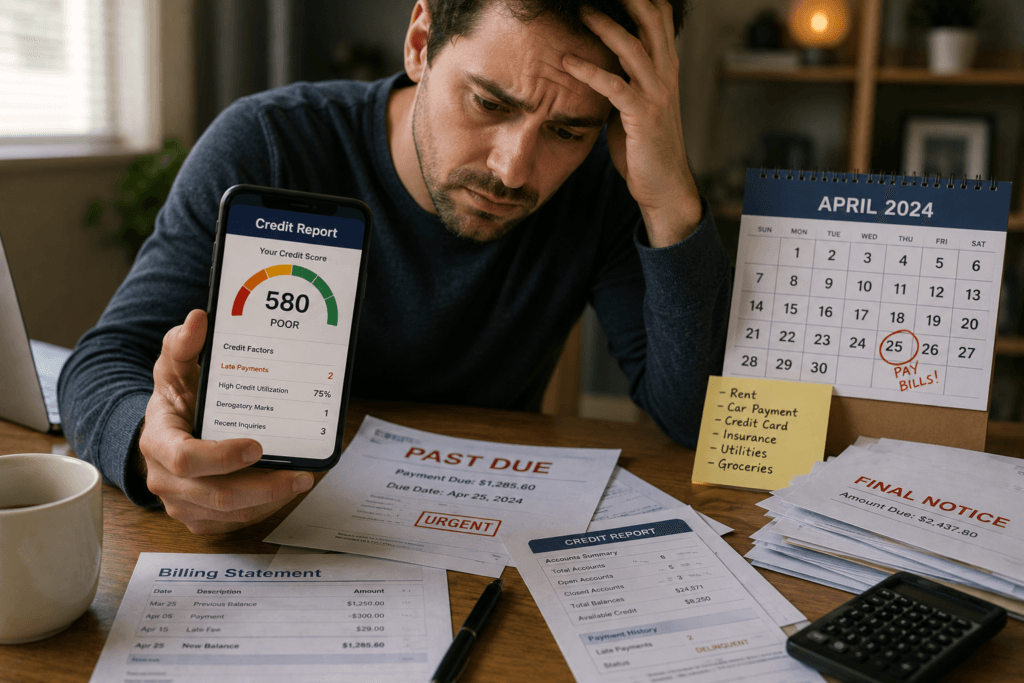
You missed a payment. Maybe you knew it was coming and couldn’t stop it. Maybe it slipped through — a bill you forgot, an autopay that didn’t process, a card you thought was paid that wasn’t. It happens to millions of Americans every year.
Now you’re wondering how bad it really is. How long will this follow you? How much will your score drop? Is there anything you can do about it?
Here’s the complete honest answer — no sugarcoating, no vague “it depends.” Just the real timeline, the real score impact, and exactly what your options are.
The Direct Answer: 7 Years — But It’s More Complicated Than That
A late payment will typically fall off your credit reports seven years from the original delinquency date. For example, a 30-day late payment reported in June 2026 would drop off your reports in June 2033.
Seven years sounds brutal. And it is — if you do nothing and let the damage sit. But here’s the part most people don’t hear: the impact of a late payment on your score doesn’t stay constant for all seven years. It fades. Significantly. And faster than you think.
By year two or three, if you’ve been paying on time consistently, the late payment’s effect on your score is significantly reduced. By year six, it’s barely pulling you down. And at the seven-year mark, it’s gone entirely.
That changes the way you should think about this. The question isn’t just “how long does it stay?” — it’s “how quickly can I reduce its impact?” And the answer to that question is almost entirely in your control.
The 30-Day Rule: When a Late Payment Actually Becomes Official
Here’s something that surprises a lot of people: missing your payment due date by one day does not put a late payment on your credit report.
A credit card payment is generally considered late after the due date passes, but short delays typically don’t impact your credit right away. Generally, creditors will report a late payment to the credit bureaus after it’s 30 days past due. If a payment that brings the account current is made before the account is 30 days past due, the late payment typically won’t appear on credit reports from the three major credit bureaus.
This is the most important window in the entire process. If you catch a missed payment within 29 days — before it hits the 30-day threshold — you can pay it and keep it off your credit report entirely. You’ll still owe a late fee and possibly a higher interest charge. But your credit score stays clean.
The moment it crosses 30 days without payment, the lender is permitted to report it to Equifax, Experian, and TransUnion. Most do. That’s when the clock starts.
How Much Does a Late Payment Actually Drop Your Score?
This is the question everybody wants answered with a real number. The honest answer is that it varies — but here’s the actual range based on how late the payment is and where your score starts.
Late payments are one of the biggest contributors to a drop in your credit score. Since payment history accounts for 35% of your FICO score, it’s critical to avoid missing payments whenever possible. A 30-day late payment may cause a small dip in your score, especially if you have a good credit history. A 60–90 day late payment causes a more significant drop.
Here’s the breakdown in real numbers:
| How Late | Score Impact (Good Credit, 720+) | Score Impact (Fair Credit, 620–680) |
|---|---|---|
| 29 days or less | Zero — not reported | Zero — not reported |
| 30 days late | 60–80 point drop | 20–40 point drop |
| 60 days late | 80–110 point drop | 35–60 point drop |
| 90 days late | 90–130 point drop | 50–80 point drop |
| 120+ days late | 100–150 point drop | 60–100 point drop |
| Charge-off (180 days) | Up to 150+ point drop | 80–120 point drop |
Notice something counterintuitive in that table: a late payment hurts people with higher scores more than people with lower scores. That’s not a mistake.
A late payment can cause your credit score to drop more if your current score is excellent rather than at a lower point on the credit-scoring scale. Missing one payment after another can do more harm than missing only one payment. And late payments on several accounts can trigger more damage than late payments on just one account.
If you had a 750 and it dropped 80 points to 670, that’s a lender tier change — you’ve gone from prime to near-prime, which affects your rate on every loan you apply for. If you had a 620 and it dropped 30 points to 590, you were already in subprime territory and the practical change is smaller.
What Happens at Each Stage: The Full Delinquency Timeline
Understanding what’s happening at each milestone helps you know what you’re dealing with and what you can still fix.
Day 1–29: Grace Period — Nothing Reported Yet
You missed the due date. Your lender charged you a late fee — typically $25 to $40 on a credit card. If you have a promotional 0% APR, missing a payment can trigger the penalty rate. But your credit report is still clean.
What to do: Pay immediately. Call your lender and ask them to waive the late fee — many will, especially for first-time misses with a good payment history. Get current before day 30.
Day 30: First Reported Delinquency
Lenders typically report a late payment to a credit bureau only after it is 30 or more days past due. The negative impact of a late payment on your credit score decreases as time passes.
Once reported, the late payment appears on your credit file and your score drops. The lender will continue reporting the account as delinquent every month you remain unpaid.
What to do: Pay everything you owe immediately to bring the account current. The late payment stays on your report — you can’t erase what was already reported — but stopping the bleeding prevents additional monthly delinquency marks from stacking up.
Day 60–90: Escalating Delinquency
Each additional month you’re late gets reported separately. A 60-day late payment and a 90-day late payment are distinct negative marks, each carrying their own weight in your credit score calculation. Two or three consecutive months of missed payments on a single account does significantly more damage than one missed payment.
What to do: If you can’t pay in full, call the lender and ask about hardship programs, payment deferrals, or reduced minimum payment options. Most major lenders have programs for customers in genuine financial distress — they’d rather work with you than send the account to collections.
Day 120–150: Serious Delinquency
At this stage, lenders typically escalate the account internally and may begin the transfer process to collections. Your credit score has taken significant damage. The account may be flagged as “seriously delinquent” in your credit file.
Day 180: Charge-Off
Missing payments for 6 months or more may result in a charge-off, which is when the creditor declares the debt a total loss and may sell it to a collection agency. Charge-offs can also negatively impact your credit score.
A charge-off is one of the most damaging entries that can appear on a credit report. It signals that the original creditor gave up on collecting the debt. The account is typically sold to a collection agency, which then creates a second negative entry on your report — the collection account — in addition to the original charge-off.
At this point, you’re dealing with two separate negative items for the same debt: the charge-off from the original creditor and the collection account. Both stay for 7 years from the original delinquency date.
The Fading Effect: How Your Score Recovers Over Time
Here’s the genuinely encouraging part — and the part that should motivate you to start paying on time immediately after a late payment.
The good news is that the effect fades over time. Though the late mark won’t disappear, resolving late payments could still improve your credit score over time.
Credit scoring models, including FICO, weight recent behavior more heavily than old behavior. A late payment from six years ago barely affects your score. A late payment from six months ago is still causing serious damage. The exact same entry has completely different scoring weight depending on its age.
Practical timeline for someone who had one 30-day late payment and has been paying on time since:
| Time Since Late Payment | Impact on Score |
|---|---|
| 0–6 months | Maximum damage — 60–100 point drop |
| 6–12 months | Starting to fade — consistent on-time payments rebuilding |
| 1–2 years | Significant recovery — 30–50 points recovered |
| 2–4 years | Minimal impact — most lenders looking at recent history |
| 4–6 years | Nearly irrelevant to your score |
| 7 years | Gone from report entirely |
The single most powerful thing you can do after a late payment is make every subsequent payment on time. Not some of them. Every single one. Each on-time payment is a data point pushing the late payment further into your past and reducing its weight in your score.
Can You Remove a Late Payment Before 7 Years?
Sometimes. There are two legitimate routes.
Route 1 — Dispute It If It’s Inaccurate
You can sometimes remove a late payment from your credit reports — but not always. If the late payment was reported in error — you actually paid on time but the lender misapplied the payment, the payment posted after their cutoff time through no fault of yours, or the date on the report is simply wrong — you have the right to dispute it.
File a dispute with the credit bureau where the error appears. Include documentation: bank statements showing the payment went through, screenshots of the transaction, anything that proves the payment was made. The bureau has 30 days to investigate. According to ConsumerAffairs’ January 2026 late payment guide, the actual reporting timelines depend on which credit bureau your lender uses and how late the payment was — and disputing inaccurate late payments is your legal right under the Fair Credit Reporting Act.
Route 2 — Goodwill Letter to the Original Creditor
If the late payment was legitimate — you actually did miss it — you can write a goodwill letter to the original creditor asking them to remove it as a courtesy. This is not a legal right. The creditor is under no obligation to remove an accurate negative item.
But many do. Especially for customers who:
- Have a long, otherwise clean payment history with that creditor
- Have a legitimate hardship story (medical emergency, job loss, natural disaster)
- Have paid the late amount in full and maintained a good record since
According to Citi’s credit education guide, there are ways to help prevent late payments from hurting your score — and addressing the situation directly with your creditor as soon as possible gives you the best odds of a favorable response.
The goodwill letter script: “I am writing regarding the late payment reported on my account [number] for [month/year]. I want to acknowledge that this payment was missed due to [brief explanation]. I have since paid the account in full and maintained a perfect payment record. I am respectfully requesting that you consider removing this late payment notation as a goodwill adjustment. I truly value my relationship with [Creditor] and am committed to maintaining excellent standing going forward.”
Send it to the creditor’s customer relations or executive office — not the collections department. Follow up after 30 days if you don’t hear back.
What About “Pay for Delete” on Late Payments?
Quick clarification: pay-for-delete is primarily a strategy for collection accounts — third-party collectors who bought your debt. For late payment notations on accounts you still have with the original creditor, the goodwill letter is the appropriate approach. They’re two different situations.
If your late payment eventually became a collection account, the strategies in our complete guide on how to remove collections from your credit report in 2026 apply — including pay-for-delete, debt validation, and formal FCRA disputes.
The Fastest Way to Rebuild After a Late Payment
There’s no shortcut that removes a legitimate late payment instantly. But there’s a clear path to minimizing the damage as fast as possible.
Step 1 — Bring the account current immediately. Every additional month of delinquency is another negative mark. Stop the bleeding first.
Step 2 — Set up autopay for every account. Not the minimum payment — at least the minimum payment. The goal is to never miss again. According to Capital One’s February 2026 late payment guide, setting up autopay is one of the most effective ways to prevent future late payments from appearing on your credit report.
Step 3 — Keep credit card utilization low. Payment history is 35% of your FICO score. Credit utilization is 30%. Lowering your balances below 30% of your limit on every card is the second-fastest way to improve your score after the late payment.
Step 4 — Don’t close old accounts. It’s tempting to close accounts after a rough patch. Don’t. Closed accounts shorten your average account age and reduce available credit — both of which can hurt your score further. Keep them open and use them lightly.
Step 5 — Try the goodwill letter. If you’ve been paying on time for at least six months since the late payment, write that goodwill letter. The worst answer is no, and you’re no worse off than before.
Quick Reference: Late Payment Timeline at a Glance
| Timeline | What’s Happening | What You Should Do |
|---|---|---|
| Day 1–29 | Not yet reported — grace period | Pay immediately. Call to waive fee. |
| Day 30 | First delinquency reported to bureaus | Pay to current. Score drops now. |
| Day 60–90 | Additional delinquency marks added | Call lender about hardship options. |
| Day 180 | Charge-off — sold to collections | Negotiate with collection agency. |
| Month 6–24 | Score gradually recovering with good behavior | Pay everything on time. Every month. |
| Year 2–4 | Late payment impact significantly reduced | Write goodwill letter if not removed. |
| Year 7 | Late payment drops off report entirely | Clean slate on this item. |
FAQ
Q1: How long does a late payment stay on your credit report? A1: A late payment stays on your credit report for seven years from the original delinquency date — the date you first missed the payment. For example, a payment missed in June 2026 would fall off your credit report in June 2033. However, the negative impact on your credit score fades significantly over time, especially if you maintain consistent on-time payments after the missed one.
Q2: How much does a late payment drop your credit score? A2: The drop depends on how late the payment is and your starting score. A 30-day late payment typically drops a good credit score (720+) by 60 to 80 points. A 90-day late payment can cause a 90 to 130 point drop for someone with excellent credit. People with lower starting scores see smaller drops because they have less to lose. The damage is most severe in the first six months and fades progressively with consistent on-time payments afterward.
Q3: Will a late payment affect my credit score if I pay it before 30 days? A3: No — if you bring the account current within 29 days of the missed due date, the late payment will not appear on your credit report. Lenders typically only report to credit bureaus after a payment is 30 or more days past due. You may still owe a late fee and interest, but your credit score remains unaffected.
Q4: Can you remove a late payment from your credit report? A4: Sometimes. If the late payment was reported in error — you actually paid on time but the lender misreported it — you can dispute it with the credit bureaus under the Fair Credit Reporting Act and have it removed. If the late payment is legitimate, you can write a goodwill letter to the original creditor asking them to remove it as a courtesy. This is not guaranteed, but many creditors will comply for customers with an otherwise clean record and a legitimate hardship explanation.
Q5: Does a late payment affect your credit score for the full 7 years? A5: No — the impact fades significantly over time. The damage is heaviest in the first 6 to 12 months. By year two or three with consistent on-time payments, the late payment’s effect is substantially reduced. By year five or six, it has minimal impact on most scores. Credit scoring models like FICO weight recent behavior much more heavily than old history, which means rebuilding good payment habits after a late payment reduces the damage faster than most people expect.
DISCLAIMER
This article is for educational purposes only. Credit score impacts vary by individual credit profile, scoring model, and creditor reporting practices. The score drop ranges described are estimates based on published data and may differ for your specific situation.

Mohammad Javed is the founder and personal finance writer behind FinanceBeliever.com. He holds a Master of Commerce (MCom) degree with a specialization in finance and financial markets. Through years of personal experience studying credit systems, debt management, investment strategies, and how everyday financial decisions impact real households, he built Finance Believer to deliver straight, research-backed financial guidance to American readers. Every article he writes is sourced from authoritative data — including the Federal Reserve, the Consumer Financial Protection Bureau, and the Bureau of Labor Statistics. His work covers credit scores, loans, banking, insurance, investing, and personal budgeting — all written in plain English without the jargon.