
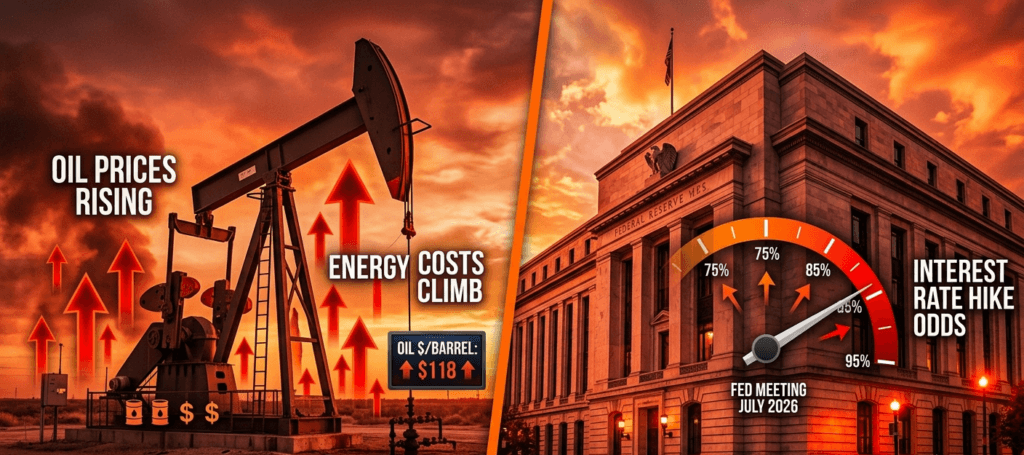
Seven days ago, almost nobody on Wall Street expected the Federal Reserve to raise interest rates in 2026. This week, that consensus has been upended.
According to CNBC’s July 23 market coverage, Fed funds futures are now pricing in a roughly 82% likelihood that the central bank lifts borrowing costs at its September policy meeting — up from below 53% just a week earlier. Even more striking, the odds of a hike at this week’s meeting have surged too: CBS News reported that the CME Group’s FedWatch tool now shows a 38% probability of a rate increase at Wednesday’s meeting, and Forbes reported the same tool hitting as high as 46.5% — up from just 10.7% on July 15.
That’s a nearly fourfold jump in market expectations in about one week. Here’s exactly why this happened and what it means for your mortgage, your savings account, and your 401(k).
What Actually Changed — Oil Above $100 a Barrel
The trigger for this dramatic shift is straightforward: oil prices have surged well above $100 a barrel amid the escalating US-Iran conflict, and that surge is threatening to reignite inflation right as it appeared to be cooling.
According to Traders Union’s market analysis, Brent crude has topped $100 a barrel and US gasoline is averaging $4 a gallon, pressuring stocks broadly — the Dow fell over 600 points as investors weighed the tighter-policy risk. The situation escalated further this week: CryptoCraft’s market news wire reported that President Trump told Axios on Thursday he is “considering a massive attack” on Iran, “larger than anything that has been done before,” adding uncertainty to an already volatile oil market.
The math connecting oil to Fed policy is direct. Rising energy costs feed almost immediately into transportation, manufacturing, and food prices — and the Fed’s mandate is specifically to keep inflation near its 2% target. According to CBS News’ reporting, resurgent inflation tied to rising energy prices has prompted some forecasters to abandon their earlier expectations of rate cuts in 2026 and instead predict higher rates before year’s end.
What Fed Officials Are Actually Saying
This isn’t just a market reaction to oil prices in isolation — Fed officials themselves have been sending increasingly hawkish signals.
According to HNGN’s July 24 coverage, Fed Governor Lisa Cook has highlighted inflation running at 3.7% — well above the central bank’s 2% target — while Vice Chair Philip Jefferson and Governor Christopher Waller have both warned of policy reconsideration if inflation doesn’t cool. Fed Chair Kevin Warsh, in his first months leading the central bank following his confirmation, has pledged to return inflation to the 2% target while offering few clues about his broader thinking — a departure from the more transparent “forward guidance” approach of his predecessors.
According to CNBC’s July 13 coverage, Governor Waller specifically warned that the Fed “must not repeat the mistakes of 2021 and 2022,” when he said the central bank waited too long to raise rates amid rising inflation — while also cautioning against overcorrecting and raising rates too quickly this time around.
Nigel Green, CEO of investment firm deVere Group, summarized the shift bluntly in a July 23 email cited by both IndexBox and CBS News: “The Fed will find holding steady a harder case to make than it looked even a few weeks ago.”
Will the Fed Actually Hike Rates This Week?
Despite the dramatic shift in market-implied odds, most economists still expect the Fed to hold rates steady at its July 28-29 meeting, with September looking like the more likely moment for any actual move.
According to IndexBox’s analysis, the Fed is widely expected to maintain its current interest rate stance of 3.5%-3.75% at the July meeting, even though the probability of a hike later in 2026 has jumped to 38%, up from just 12% a week earlier. Gregory Daco, chief economist for EY-Parthenon, offered a more nuanced read in a July 22 email cited by CBS News: “While a July rate hike remains highly unlikely, the September FOMC meeting could become the first meaningful test of whether the recent improvement in inflation proves durable.”
According to CNBC’s July 23 coverage, economists’ broader interest rate outlook through 2026 still doesn’t signal a full tightening cycle — the consensus forecast from FactSet remains that the Fed won’t hike rates at all this year, with economists actually anticipating the central bank will lower borrowing costs by half a percentage point in 2027. In other words: the market’s short-term odds have shifted dramatically, but the professional economist consensus hasn’t fully abandoned the rate-cut narrative — yet. This gap between market pricing and economist consensus is itself a signal of how much uncertainty the oil shock has introduced.
The Other Half of the Story — Jobs Data Adding Fuel
It’s not just oil driving this shift. According to CNBC’s reporting, initial jobless claims dropped to 187,000 in the week ended July 18 — the fewest claims since 1969, when the US population was 60% of what it is today. Christopher Rupkey, chief economist at FWDBONDS, noted: “At the moment, the outlook for economic growth is showing some signs of overheating if today’s weekly jobless claims figures can be believed.”
A labor market this tight gives the Fed more room to consider raising rates without worrying about triggering a recession — reinforcing the case for a more hawkish stance precisely when oil-driven inflation risk is also rising. Two supporting factors pointing the same direction rarely align this cleanly.
What This Means for Your Mortgage
If you’re shopping for a home or considering refinancing, this shift matters directly. Treasury yields — which mortgage rates track closely — have already moved. According to Crypto Briefing’s market analysis, US 2-year Treasury yields climbed to 4.37% on July 23, their highest level since early 2025, while the 10-year benchmark reached a year-to-date high of approximately 4.7%. The 2-year yield is particularly telling because it closely tracks near-term Fed policy expectations.
Higher Treasury yields typically translate directly into higher mortgage rates within days to weeks. If you’ve been waiting for rates to come down before buying or refinancing, this week’s developments push in the opposite direction — at least in the near term. If homeownership is on your radar regardless of rate timing, our guide on how to buy a house with no money down in 2026 covers federal loan programs that remain available regardless of where rates land, and our guide on how to get a mortgage with bad credit in 2026 covers the current lending landscape for less-than-perfect credit.
What This Means for Your Savings Account
Here’s the silver lining in this story: if the Fed does eventually hike rates — whether this week or in September — savings account and CD yields typically follow upward. Banks compete more aggressively for deposits when their own cost of funds through the Fed rises, which historically translates to better rates for savers.
If you’ve been sitting on cash in a low-yield account, this is exactly the kind of environment where locking in current rates or shopping for better yields pays off. Our current roundup of the best CD rates in July 2026 and our guide on high-yield savings accounts vs. money market accounts cover exactly where to find competitive rates right now, before any further shifts happen.
What This Means for Your 401(k) and Investments
Higher interest rate expectations typically pressure stock valuations, particularly for growth stocks whose value depends heavily on future earnings discounted back to today’s dollars. According to Traders Union’s reporting, US equities came under broad pressure even while major indexes remained relatively close to record highs, as investors weighed tighter-policy risk alongside other headwinds like AI spending concerns.
The historical pattern through similar episodes offers some context. According to Crypto Briefing’s analysis, back in March 2026, when oil prices staged a similar surge, Bitcoin traded between $64,000 and $71,000 amid significant volatility — illustrating how risk assets broadly react to this kind of macro uncertainty, not just traditional equities.
For most long-term retirement investors, the right response to a single week of dramatic rate-odds repricing is generally no response at all. Short-term volatility driven by shifting Fed expectations is a normal part of investing, and reactive selling based on a single week’s news typically costs more than it protects. If you’re building your long-term strategy and deciding between account types, our detailed comparison of Roth IRA vs. 401(k) in 2026 remains relevant regardless of this week’s Fed odds.
What Happens Next — This Week’s Timeline
Monday-Tuesday, July 28: The Federal Open Market Committee begins its two-day meeting.
Wednesday, July 29: The Fed announces its rate decision, followed by Chair Kevin Warsh’s press conference. Given his stated preference for less forward guidance than his predecessors, markets may get fewer hints about the path beyond this meeting than they’re used to.
What to watch for: Even if the Fed holds rates steady as most economists expect, the accompanying statement language and Warsh’s press conference tone will be scrutinized heavily for hints about September. Any indication that officials are seriously considering a hike would likely push mortgage rates and Treasury yields higher immediately, regardless of what happens with the actual rate this week.
The bigger wildcard: Continued escalation in the US-Iran conflict and further oil price increases could accelerate this timeline. As one industry analyst put it in coverage from IFA Online, the stock market “can no longer brush off war” when oil is sitting above $100 a barrel — a dynamic that could keep pushing rate expectations around sharply in either direction as the geopolitical situation develops.
Frequently Asked Questions
Will the Federal Reserve raise interest rates this week? Most economists still expect the Fed to hold rates steady at 3.5%-3.75% at its July 28-29 meeting, though the probability of a hike has risen dramatically — from around 10-12% a week ago to as high as 38-46.5% according to different measures of the CME FedWatch tool. September 2026 is viewed by many economists as the more likely timing for an actual rate increase if inflation doesn’t cool.
Why did Fed rate hike odds jump so much in one week? Oil prices surged above $100 a barrel amid the escalating US-Iran conflict, threatening to reignite inflation that had appeared to be cooling. Combined with stronger-than-expected labor market data (jobless claims hitting a multi-decade low) and hawkish comments from several Fed officials, market-implied rate hike odds nearly quadrupled within about a week.
How does a Fed rate hike affect mortgage rates? Mortgage rates closely track Treasury yields, which have already risen in anticipation of potential Fed action — the 10-year Treasury yield hit a year-to-date high around 4.7% in late July 2026. If the Fed does hike rates, whether this week or in September, mortgage rates would likely rise further, making home purchases and refinancing more expensive.
Is this good or bad news for my savings account? It’s good news for savers specifically. If the Fed raises rates, banks typically respond by offering higher yields on savings accounts and CDs to remain competitive for deposits. If you’ve been holding cash in a low-yield account, this environment makes it a good time to shop for better rates before any further changes.
Should I change my investment strategy because of this news? For most long-term investors, no single week of shifting Fed rate expectations should trigger a change in strategy. Markets react to shifting probabilities constantly, and reactive trading based on short-term rate speculation typically underperforms a consistent, long-term approach. Stay invested according to your existing plan and revisit your strategy only if your personal financial circumstances change.
This article is for informational and educational purposes only and does not constitute financial or investment advice. Market conditions and Federal Reserve policy can change rapidly. Always consult a qualified financial advisor before making investment decisions based on monetary policy developments.

Mohammad Javed is the founder and personal finance writer behind FinanceBeliever.com. He holds a Master of Commerce (MCom) degree with a specialization in finance and financial markets. Through years of personal experience studying credit systems, debt management, investment strategies, and how everyday financial decisions impact real households, he built Finance Believer to deliver straight, research-backed financial guidance to American readers. Every article he writes is sourced from authoritative data — including the Federal Reserve, the Consumer Financial Protection Bureau, and the Bureau of Labor Statistics. His work covers credit scores, loans, banking, insurance, investing, and personal budgeting — all written in plain English without the jargon.