
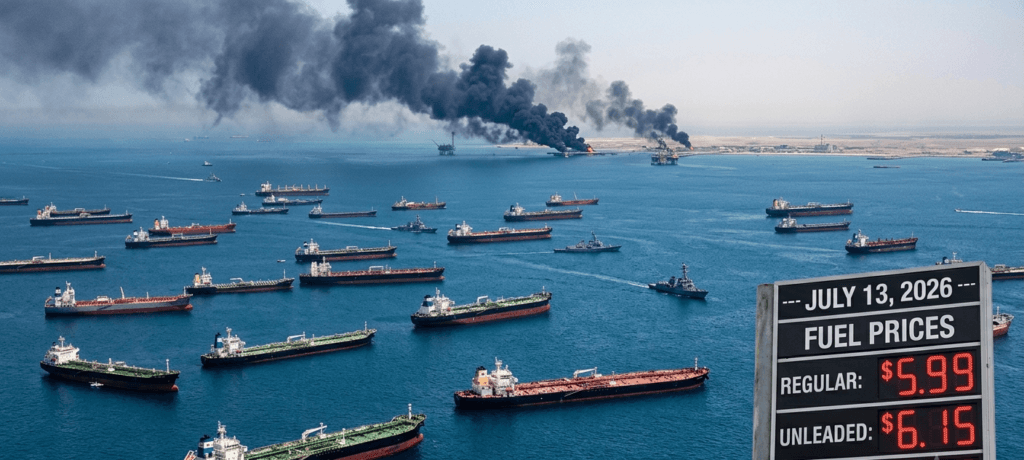
Oil prices spike in 2026 because of the Strait of Hormuz crisis — and this morning, that crisis got significantly worse.
If you checked gas prices this weekend and thought something felt off, here’s why: the United States and Iran traded military strikes overnight, Iran declared the Strait of Hormuz closed “until further notice,” and oil markets opened Monday July 13 with Brent crude jumping more than 4% to near $79 a barrel. West Texas Intermediate — the US benchmark — surged to around $74 a barrel.
This isn’t a distant geopolitical story. gas prices have risen $1.16 a gallon in the United States since the start of the US-Iran war in late February, according to Wikipedia’s comprehensive 2026 Iran war fuel crisis tracker, according to Wikipedia’s comprehensive fuel crisis tracker. And if the Strait of Hormuz stays disrupted, analysts warn prices could hit $5.00 a gallon or higher across much of the country. Here’s what’s actually happening and what it means for your money.
What Happened Overnight — The Full Picture
The current crisis stems from a breakdown in a fragile ceasefire that the US and Iran signed on June 17, 2026. That agreement was supposed to reopen the Strait of Hormuz — the narrow waterway between Iran and Oman through which roughly 20% of the world’s oil supply flows in normal times.
The problem: the ceasefire never fully resolved who actually controls the strait. Iran claimed ships had to use a northern route through its territorial waters. The US insisted the strait is an international waterway and ships could use any route they chose.
That disagreement turned violent again last week. According to CNBC’s live market coverage, the US military launched waves of strikes on Iran on Saturday and Sunday in retaliation for Iranian Revolutionary Guard attacks on commercial container ships transiting Hormuz. The US hit more than 140 targets over the weekend. Iran responded with strikes on US military facilities in Jordan, Kuwait, Bahrain, and Oman.
This morning, Al Jazeera confirmed that just 6 vessels crossed the strait between Thursday evening and Friday morning — compared with 18 to 22 daily crossings earlier this month, and roughly 130 vessels per day before the war began in February. That’s a collapse in traffic to less than 5% of pre-war levels.
Bloomberg reported that Iran declared the strait closed “until further notice” — a claim that US Central Command immediately denied, saying US forces had conducted strikes specifically to ensure freedom of navigation.
The market doesn’t care who’s right. When there’s genuine uncertainty about whether 20% of global oil supply can get to market, prices go up. That’s what happened this morning.
What This Means for Gas Prices Right Now
Here’s the number every American driver cares about: how much more will gas cost?
The relationship between crude oil prices and pump prices isn’t instant — there’s a lag of roughly 2 to 4 weeks as refiners process crude and distributors reprice fuel. But the direction is clear.
According to Wikipedia’s 2026 Iran war fuel crisis documentation, fuel prices across North America have gone up significantly since early March. Gas prices have risen $1.16 a gallon since the start of the war, with prices expected to hit $5.00 a gallon if the Strait of Hormuz is not opened. In California, prices already surpassed $6 a gallon in seven counties earlier this year.
Today’s 4% spike in crude adds approximately $0.09 to $0.12 per gallon to eventual pump prices, assuming it holds. That sounds small, but it compounds on top of prices that are already elevated from months of geopolitical tension.
According to XAnalysts founder Mukesh Sahdev, quoted by Al Jazeera, Brent is likely to stay in the upper $70s through August and September “amid heightened geopolitical uncertainty.” That forecast assumes no further major escalation — which is a significant assumption given this morning’s events.
Why the Strait of Hormuz Matters So Much
The Strait of Hormuz is 21 miles wide at its narrowest point. It connects the Persian Gulf — where Saudi Arabia, Iraq, Kuwait, the UAE, and Iran’s oil terminals are located — to the broader ocean. There is no practical alternative route for most of that oil.
The IEA characterized the 2026 disruption as “the largest supply disruption in the history of the global oil market” — a designation that gives you a sense of just how consequential this chokepoint is. Before the war began, roughly 130 vessels transited the strait every single day. That number has collapsed to single digits on the worst days of the current conflict.
The global economy had been adjusting — finding alternative suppliers, drawing down strategic petroleum reserves, rerouting tankers around the Cape of Good Hope (adding weeks to delivery times and significant cost). But those adjustments have limits. The longer the strait stays disrupted, the more the workarounds break down.
What Happens to Your Grocery Bill
This is the part that hits hardest for most American families — and it’s the part that gets least attention in market coverage.
Oil isn’t just gasoline. It’s the input cost for almost everything that gets transported, manufactured, or grown at scale. When crude prices spike:
Food prices go up — because farmers use diesel fuel for tractors and harvesting equipment, and because almost everything you eat gets trucked from farm to distribution center to store. The US Department of Agriculture estimated that every $10 increase in the per-barrel price of oil adds approximately 0.5% to overall grocery prices within 3 to 6 months.
Airline tickets go up — jet fuel is refined from crude oil. Airlines hedge their fuel costs but not perfectly. United Airlines, which reports earnings Tuesday July 15, is expected to flag higher fuel cost assumptions for Q3.
Utilities may go up — some electricity is generated from natural gas, whose price correlates with oil. Heating costs this winter could be affected if disruption continues through the fall.
Everything shipped long distances gets more expensive — which in America is almost everything. If you’ve been tracking grocery prices since the war began in February, Reuters has documented a direct correlation between Middle East oil disruption and US consumer price inflation.
What the Stock Market Is Doing Right Now
Google Finance’s live market data for July 13, 2026 confirms crude oil prices spiked over 4% this morning following a weekend of renewed airstrikes between the US and Iran — while US officials claim the Strait of Hormuz remains open, Iranian assertions of its closure have stoked global inflation fears and pressured Asian equity markets.
Specifically: Japan’s Nikkei 225 fell more than 2% in Monday trading, South Korea’s Kospi plunged more than 8%, and US futures opened lower before partially recovering. The Dow Jones futures pointed to a decline at the open.
For American investors, the immediate concern is what rising oil prices mean for the Federal Reserve’s rate path. The Fed under Chairman Kevin Warsh has already signaled a potential rate hike — futures markets are pricing in a 61% chance of a September hike according to the CME FedWatch Tool. If oil-driven inflation reaccelerates, the case for hiking gets stronger — which is bad for stocks, bonds, and mortgage rates simultaneously.
The irony is that this week was already supposed to be a critical week for markets, with five major bank earnings (JPMorgan, Goldman Sachs, Wells Fargo, Citigroup, Bank of America) all reporting Tuesday morning, plus the June CPI inflation report. Now all of those numbers will be interpreted through the lens of whatever oil does today and tomorrow.
The Investment Angle — What’s Moving Right Now
For investors trying to understand what to do with their portfolios in this environment:
Energy stocks are rising — predictably. When crude spikes, companies that produce oil and gas see their revenues go up. ExxonMobil, Chevron, ConocoPhillips, and similar names tend to move higher when crude spikes. If you hold an S&P 500 index fund, energy is roughly 4-5% of the index, so you have some indirect exposure already.
Defense stocks are rising — Lockheed Martin, Raytheon, Northrop Grumman all benefit from elevated Middle East military activity. This has been a consistent pattern throughout the 2026 conflict.
Transportation stocks are falling — airlines, shipping companies, and trucking firms face higher input costs when fuel prices rise. Delta Air Lines just reported earnings Friday; United Airlines reports Tuesday. Watch their fuel cost guidance carefully.
The broader market is under pressure — not catastrophically, but meaningfully. the S&P 500 is already up nearly 11% year to date according to CNBC’s market outlook according to CNBC’s market outlook, and some strategists were already warning about elevated valuations. Oil-driven inflation adding to Fed hawkishness is exactly the scenario that could trigger the correction Bank of America’s strategists have been warning about with their 7,100 year-end target.
For most ordinary Americans with 401(k) accounts: stay invested, don’t panic, and understand that this is a risk that was already partly priced into markets. If you’re not sure how your retirement account is positioned, our guide on Roth IRA vs. 401(k) — which one to use in 2026 walks through how to think about tax treatment and risk allocation in volatile environments.
What You Can Actually Do Right Now
Fill your gas tank today — before the crude price spike filters through to pump prices over the next 2 to 4 weeks. This isn’t panic buying — it’s just timing. You’re going to need gas anyway.
Check your budget for energy costs — if you’ve been budgeting based on current gas prices, update your projections. A $0.30 to $0.50 per gallon increase over the next month is plausible if the strait disruption continues. Our guide on how to budget using the 50/30/20 rule helps you reallocate quickly when one expense category spikes.
Don’t make reactive investment decisions — the worst thing most Americans do in geopolitical crises is sell investments out of fear. The S&P 500 has recovered from every single geopolitical shock in its history, including both Gulf Wars, 9/11, the 2014 Ukraine crisis, and the 2020 pandemic. If your time horizon is more than 5 years, stay invested.
Watch the CPI report Tuesday morning — the June Consumer Price Index releases at 8:30 AM ET on July 14, the same morning as bank earnings. If CPI comes in hot, combined with oil spiking, the Fed rate hike probability goes up significantly. That’s the scenario that moves mortgage rates, savings account yields, and stock valuations all at once.
What Analysts Are Saying About Where Oil Goes From Here
The range of professional forecasts right now is unusually wide — reflecting genuine uncertainty about how the conflict resolves.
XAnalysts’ Sahdev forecasts Brent in the upper $70s through summer with “occasional spikes and dips.” That’s the base case — continued tension but no full-scale escalation.
The bull case for oil: Iran fully closes the strait, tanker traffic drops to near zero, emergency reserves run low, and Brent breaks back above $100. That’s what analysts were pricing in back in March when the war first started.
The bear case for oil: the US and Iran reach a new ceasefire agreement this week — negotiations in Doha, Qatar are reportedly being planned — and traffic normalizes. Prices could give back today’s gains quickly.
IG Australia’s Tony Sycamore put it most clearly: “It remains to be seen whether this morning’s US strikes bring a swift end to the latest escalation or Iran elects to continue flexing its leverage over the Strait with actions that fall short of triggering a broader conflict. At the very least, it will keep markets on edge.”
That uncertainty is precisely why oil is trading with elevated volatility and a risk premium right now. When the situation resolves — one way or the other — prices will move sharply. The direction depends entirely on what happens in Doha.
Key Numbers to Watch This Week
| Metric | Current Level | What to Watch |
|---|---|---|
| Brent Crude | ~$79/barrel (+4% today) | $80 resistance — break above signals more pain |
| WTI Crude | ~$74/barrel | $75 psychological level |
| Strait Tanker Crossings | 6/day (vs 130 pre-war) | Any increase signals de-escalation |
| US Average Gas Price | ~$3.85/gallon | Watch for $4.00 breach in next 2-3 weeks |
| June CPI (releases Tue 8:30 AM) | Previous: 2.8% YoY | Hot print = Fed hike more likely |
| S&P 500 | ~7,480 | 7,100 (BofA bear target) vs 8,250 (Yardeni bull) |
| Fed Hike Probability (Sept) | 61% | Watch post-CPI and Warsh testimony |
Frequently Asked Questions
Why did oil prices spike so much today July 13, 2026? The US and Iran traded military strikes overnight over the Strait of Hormuz — the waterway that carries roughly 20% of the world’s oil supply. Iran declared the strait closed “until further notice,” triggering a 4%+ jump in Brent crude to near $79 a barrel this morning. Oil markets price in supply disruption risk immediately, even before actual shortages develop.
How much will gas prices go up because of this? There’s typically a 2 to 4 week lag between crude oil price changes and pump price changes. Today’s 4% crude spike could add $0.09 to $0.12 per gallon to gas prices in the coming weeks, on top of prices already elevated by months of Middle East disruption. If the strait stays closed, prices could push toward $5 nationally.
Should I sell my stocks because of the oil price spike? Historically, geopolitical oil shocks cause short-term market volatility but not permanent damage to long-term investors. The S&P 500 recovered from both Gulf Wars, 9/11, and every major oil shock in the last 50 years. Unless your time horizon is very short, reactive selling typically does more harm than staying invested.
What does the Strait of Hormuz closure mean for inflation? Higher oil prices feed directly into transportation costs, food prices, manufacturing costs, and utilities. The June CPI report releases Tuesday July 14 — if it shows inflation re-accelerating, combined with oil spiking, the Federal Reserve becomes more likely to hike interest rates in September. That affects mortgage rates, savings yields, and stock valuations.
Is the Strait of Hormuz actually closed right now? There is genuine disagreement between the US and Iran. Iran’s state media says the strait is closed “until further notice.” US Central Command says it is not closed and that US forces are ensuring freedom of navigation. As of Monday morning, only 6 vessels crossed the strait over a recent 12-hour period, compared with 130 per day before the war — suggesting significant de facto disruption regardless of official statements.
This article is for informational purposes only and does not constitute financial or investment advice. Oil prices and geopolitical situations can change rapidly. This article reflects conditions as of Monday July 13, 2026. Always consult a qualified financial advisor before making investment decisions based on market events.

Mohammad Javed is the founder and personal finance writer behind FinanceBeliever.com. He holds a Master of Commerce (MCom) degree with a specialization in finance and financial markets. Through years of personal experience studying credit systems, debt management, investment strategies, and how everyday financial decisions impact real households, he built Finance Believer to deliver straight, research-backed financial guidance to American readers. Every article he writes is sourced from authoritative data — including the Federal Reserve, the Consumer Financial Protection Bureau, and the Bureau of Labor Statistics. His work covers credit scores, loans, banking, insurance, investing, and personal budgeting — all written in plain English without the jargon.