
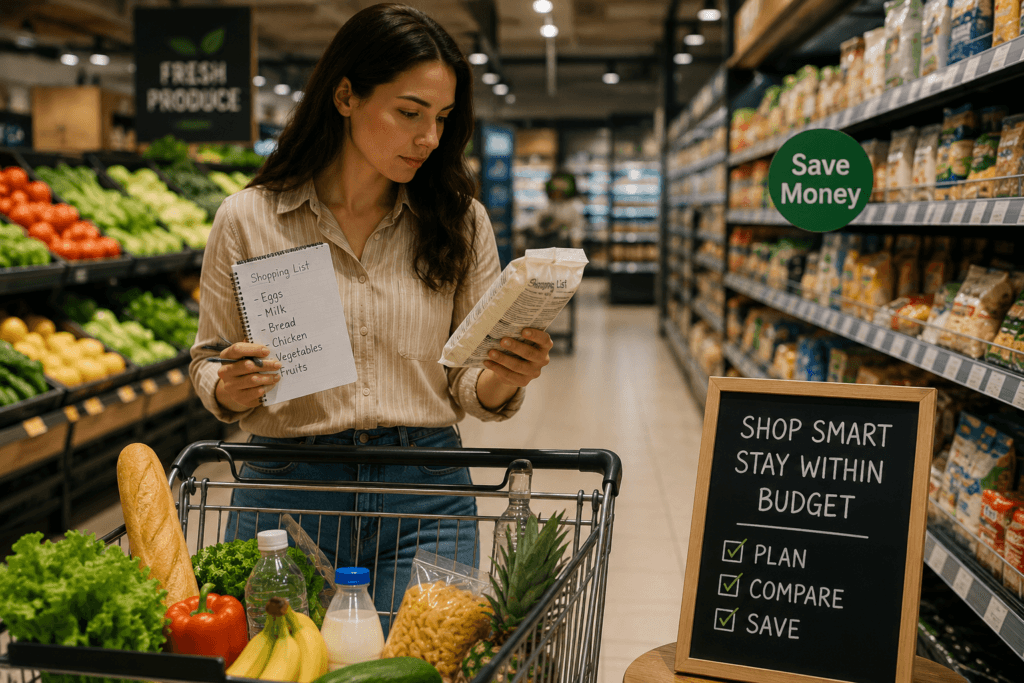
Grocery prices hit you differently now than they did three years ago. You’re not imagining it — you’re buying roughly the same things, and the total at checkout is materially higher than it used to be.
According to Groupon’s April 2026 grocery savings analysis, food costs are still 20–25% higher than pre-pandemic levels according to USDA data, and for a family of four that’s an extra $80 to $120 per month compared to just a few years ago — and most households haven’t changed how they shop to keep up.
Here’s what Groupon’s analysis also found: layering strategies — store sales, loyalty points, a warehouse membership, and a cash-back card — can realistically bring a $600 per month grocery bill down to under $450. That’s $150 a month — $1,800 a year — with no changes to what you eat.
This guide covers the 12 strategies that actually create those savings. Not extreme couponing. Not driving to four different stores. Real habits that fit into a normal American schedule.
Strategy 1 — Meal Plan Before You Shop (Not After)
This is the foundation of every other strategy on this list. According to PlanEat AI’s May 2026 grocery guide, the smartest ways to save money on groceries start with planning a basic weekly menu, checking what you already have before shopping, and using a grouped grocery list — this framework alone eliminates the impulse buys and duplicate purchases that quietly inflate most household grocery bills.
The specific habits that make meal planning actually stick:
- Plan your week’s meals on Sunday before you shop
- Check your pantry, fridge, and freezer before writing the list — you probably have more than you realize
- Group your shopping list by store section so you move through efficiently without backtracking (and impulse grabbing)
- Build meals around what’s already in your kitchen first, then fill in gaps
Food Chain Magazine’s February 2026 analysis confirms that meal planning helps you avoid impulse purchases and ensures every item you buy has a purpose — and once you incorporate this habit into your routine, the savings become noticeable and long-lasting.
Strategy 2 — Switch to Store Brands on the Right Items
This is probably the fastest single change that cuts your bill without changing what you eat.
Store brands — also called private label, generic, or “own brand” — are manufactured by the same factories that produce name brands. Not always, but often enough that the difference in quality on staples is negligible. According to Yahoo Finance’s April 2026 grocery guide, there are endless ways to save money at the grocery store, and one of the most reliable is switching to store brands on items where the quality difference is minimal.
Where store brands consistently match name brands in quality:
- Canned goods (beans, tomatoes, corn, tuna)
- Dried pasta and rice
- Flour, sugar, baking staples
- Frozen vegetables
- Cooking oils
- Over-the-counter medications (generic ibuprofen is the same molecule as Advil)
- Cleaning supplies
Where name brands sometimes genuinely differ: coffee, specific sauces or condiments where you notice the flavor, and personal care items you have preferences about. Start with staples, keep the name brands where they matter to you.
Strategy 3 — Use Grocery Cashback Apps — Ibotta, Rakuten, Flipp
These apps take two minutes to set up and run silently in the background while you shop normally. According to Kbils’ 2026 grocery savings guide, if you spend $500 per month on groceries, using cashback apps like Ibotta or Rakuten can save $25 to $50 monthly — that’s $300 to $600 annually for a typical American family.
Ibotta: Upload your receipt after shopping or link your store loyalty card. Ibotta matches items you bought with available offers and deposits cash directly — no points, actual money.
Rakuten: Primarily online, but has in-store cashback offers at many grocery chains. The Rakuten browser extension also activates automatically when you order groceries online from participating retailers.
Flipp: Aggregates weekly circular deals from every grocery store in your zip code into one app. Lets you compare which store has your staples on sale this week before you leave the house.
None of these require clipping physical coupons or changing stores. They work with your normal shopping routine.
Strategy 4 — Use a Cash-Back Credit Card on Groceries (Pay It in Full Monthly)
This is free money for spending you’re already doing — with one important condition.
According to Groupon’s 2026 analysis, if you pay your balance in full each month, using a cash-back credit card on groceries is essentially free money — several cards offer 3% to 6% back on grocery purchases, and at $500 per month in grocery spending a 4% cash-back card returns around $240 a year. Groupon highlights three cards worth comparing specifically: the Blue Cash Preferred card at 6% at US supermarkets with a $95 annual fee, the Citi Custom Cash at 5% on your top spend category with no annual fee, and Capital One SavorOne at 3% with no annual fee.
Yahoo Finance’s grocery guide also points specifically to this strategy: save money on your grocery trip with a rewards credit card — these are consistently among the top cards for grocery purchases available right now.
The one condition: this only saves you money if you pay the full balance every month. Carrying a balance at 20%+ APR wipes out any cashback benefit immediately. If you’re currently carrying credit card debt, skip this strategy until the balance is cleared.
Strategy 5 — Buy in Bulk Strategically (Not Indiscriminately)
Warehouse clubs like Costco, Sam’s Club, and BJ’s are not automatically better value. They’re better value for the right items bought by the right households.
According to Kbils’ 2026 bulk buying guide, buying in bulk is one of the most effective ways to save money on groceries, but it works best when done strategically — many Americans make the mistake of purchasing large quantities of perishable items that spoil before they can be used, and you should focus on non-perishable essentials to get maximum value.
Best bulk items to buy at warehouse clubs:
- Paper products (toilet paper, paper towels)
- Cleaning supplies
- Laundry detergent
- Canned goods and pantry staples
- Cooking oils and condiments
- Frozen meats (if you have freezer space)
- Nuts, dried fruit, protein bars
Groupon’s analysis confirms that warehouse clubs make the most sense for families spending $250 or more per month on groceries and household staples. If you’re a single person or small household, a warehouse membership may cost more than it saves — run the math for your specific situation before joining.
Strategy 6 — Shop Store Sales and Build a “Price Book”
Every store runs weekly sales, and the same items cycle through sales roughly every 6 to 8 weeks. Knowing your regular prices — what something costs at normal price versus sale price — lets you stock up when an item hits its low point and skip it when it’s full price.
A “price book” sounds complicated. In practice, it’s just noting in your phone what your 20 most-purchased items normally cost so you recognize a genuine deal versus a fake sale. Some stores mark items “on sale” that are actually the same price or barely discounted — a price book exposes this immediately.
Strategy 7 — Compare Cost Per Unit, Not Package Price
This is the grocery math most people skip — and it costs them real money.
A 12-ounce box of cereal priced at $4.50 and an 18-ounce box at $5.99 look close. But the cost per ounce is $0.375 for the 12-ounce and $0.333 for the 18-ounce. The bigger box is the better deal. Yahoo Finance’s guide emphasizes this directly: make sure you consider the cost per unit to find out which product is actually the most affordable.
Every US grocery store is legally required to post the cost-per-unit shelf label. It’s the small print below the price tag. Get in the habit of checking it on every purchase and the math becomes automatic within a few shopping trips.
Strategy 8 — Reduce Food Waste (You’re Probably Throwing Away $150+ Per Month)
This is the grocery savings strategy most people never calculate — because it doesn’t feel like spending.
The USDA estimates that the average American household throws away roughly 30% to 40% of the food it buys. On a $600 monthly grocery bill, that’s $180 to $240 of food going straight into the trash. Food Chain Magazine’s 2026 analysis confirms that reducing food waste at home is one of the five core strategies to make your grocery budget go further — efficient shopping habits minimise waste and make planning more organised.
Practical waste reduction habits:
- Store produce correctly — most vegetables last longer in the crisper drawer
- Use a “eat this first” section of your fridge for items close to expiry
- Freeze bread, meat, and leftovers before they go bad rather than after
- Plan meals specifically around items that are approaching their use-by date
- Cook once, eat twice — soups, stews, and grains all stretch across multiple meals
Strategy 9 — Shop Discount Grocers and Compare Across Chains
Not all grocery stores charge the same prices for the same items. Aldi, Lidl, and Walmart consistently price staples 10% to 30% below traditional supermarkets. For a household spending $500 per month on groceries, shopping primarily at a discount grocer for staples could save $600 to $1,800 per year with zero other behavioral changes.
The common objection is selection — discount grocers carry fewer brands and SKUs. For most households, the items you actually buy regularly are available at Aldi or Lidl for significantly less. Reserve your traditional supermarket visits for specialty items, fresh deli selections, and anything the discount stores don’t carry.
Strategy 10 — Use Loyalty Programs at Every Store You Shop
Every major grocery chain — Kroger, Safeway, Publix, HEB, Albertsons — has a loyalty or rewards card that unlocks member pricing and accumulates fuel discounts. These programs cost nothing to join and consistently offer 5% to 15% off on sale items for cardholders versus non-cardholders.
According to Food Chain Magazine’s 2026 grocery guide, using loyalty programs and coupons is one of the five proven ways to cut grocery costs in 2026 while still eating well. Most programs also send personalized digital coupons based on your purchase history — items you already buy, discounted for you specifically.
Strategy 11 — Order Groceries Online to Avoid Impulse Spending
Grocery stores are engineered for impulse purchases. End-cap displays, checkout aisle candy, strategically placed premium products at eye level — every layout decision is optimized to increase your average basket size.
Ordering groceries online through your store’s delivery or pickup app eliminates every one of those triggers. You buy exactly what’s on your list. Multiple studies have found that online grocery shoppers consistently spend less per trip than in-store shoppers because the impulse purchase environment simply doesn’t exist.
Pickup (rather than delivery) is free at most major chains and eliminates the delivery fee entirely.
Strategy 12 — Stack All of the Above
The real gains come from combining strategies rather than relying on any single one.
According to Groupon’s April 2026 analysis, layering strategies — store sales, loyalty points, a warehouse membership, and a cash-back card — can realistically bring a $600 per month grocery bill down to under $450. Here’s what that combination looks like in practice:
| Strategy | Monthly Savings Estimate |
|---|---|
| Meal planning (eliminates waste and impulse buys) | $40–$80 |
| Switching to store brands on 30% of purchases | $25–$50 |
| Ibotta + Rakuten cashback | $25–$50 |
| Cash-back credit card (4% on $500 spend) | $20 |
| Shopping at Aldi for staples | $40–$80 |
| Combined total | $150–$280/month |
You don’t need to do all 12. Pick three or four that fit your household and shopping style and implement them consistently. The savings compound over time into real annual numbers.
Putting Grocery Savings Toward Something That Matters
Saving $150 per month on groceries doesn’t change your financial life on its own — but redirected intentionally, it does. That’s $1,800 per year that could accelerate a debt payoff, build an emergency fund, or go toward retirement savings.
Our complete guide on how to budget money using the 50/30/20 rule shows you exactly how to slot grocery savings into a structured budget so the money you free up actually goes somewhere useful rather than quietly disappearing back into spending.
And if you’re currently carrying high-interest debt alongside a stretched grocery budget, our breakdown of the best debt consolidation loans in 2026 covers how combining multiple high-rate payments into one lower-rate loan — alongside spending reductions like these grocery strategies — accelerates the path to financial stability faster than either approach alone.
FAQ
Q1: How much can the average American save on groceries in 2026? A1: According to Groupon’s April 2026 analysis, layering strategies like meal planning, store brands, loyalty programs, warehouse club membership, and a cash-back credit card can realistically reduce a $600 monthly grocery bill to under $450 — saving $150 per month or $1,800 per year. The actual savings depend on household size and which strategies you consistently apply.
Q2: What is the fastest way to reduce my grocery bill? A2: The fastest single change is switching to store brands on staples like canned goods, dried pasta, rice, and cooking oils — items where quality is virtually identical but prices are 20% to 40% lower. Combined with a grocery cashback app like Ibotta, most households see a measurable difference on their first shopping trip after making this change.
Q3: Are grocery cashback apps actually worth it? A3: Yes — Ibotta and similar apps can save $25 to $50 per month for a household spending $500 on groceries, according to 2026 data from Kbils. That’s $300 to $600 annually for approximately five minutes of setup and receipt scanning after shopping. The apps are free, pay in cash, and work on purchases you’d make anyway.
Q4: Is a Costco or Sam’s Club membership worth it for saving on groceries? A4: It depends on your household size and spending. According to Groupon’s 2026 analysis, warehouse clubs make the most financial sense for families spending $250 or more per month on groceries. For smaller households, the membership fee may not be recovered through savings. The best items to buy at warehouse clubs are non-perishables — paper products, canned goods, cleaning supplies, and laundry detergent.
Q5: Does meal planning really save money on groceries? A5: Consistently yes. Meal planning eliminates impulse purchases, prevents food waste (which costs the average American household $180 to $240 per month in discarded food), and reduces the number of trips to the store — each additional trip is an opportunity to spend unplanned money. Studies consistently find that households with a weekly meal plan spend 15% to 25% less on food than those who shop without a plan.
DISCLAIMER
Savings estimates in this article are based on published 2026 data and typical household spending patterns. Individual results vary based on household size, location, store availability, and shopping habits. Credit card rewards strategies only save money if the full balance is paid monthly — carrying a balance eliminates any benefit.

Mohammad Javed is the founder and personal finance writer behind FinanceBeliever.com. He holds a Master of Commerce (MCom) degree with a specialization in finance and financial markets. Through years of personal experience studying credit systems, debt management, investment strategies, and how everyday financial decisions impact real households, he built Finance Believer to deliver straight, research-backed financial guidance to American readers. Every article he writes is sourced from authoritative data — including the Federal Reserve, the Consumer Financial Protection Bureau, and the Bureau of Labor Statistics. His work covers credit scores, loans, banking, insurance, investing, and personal budgeting — all written in plain English without the jargon.