
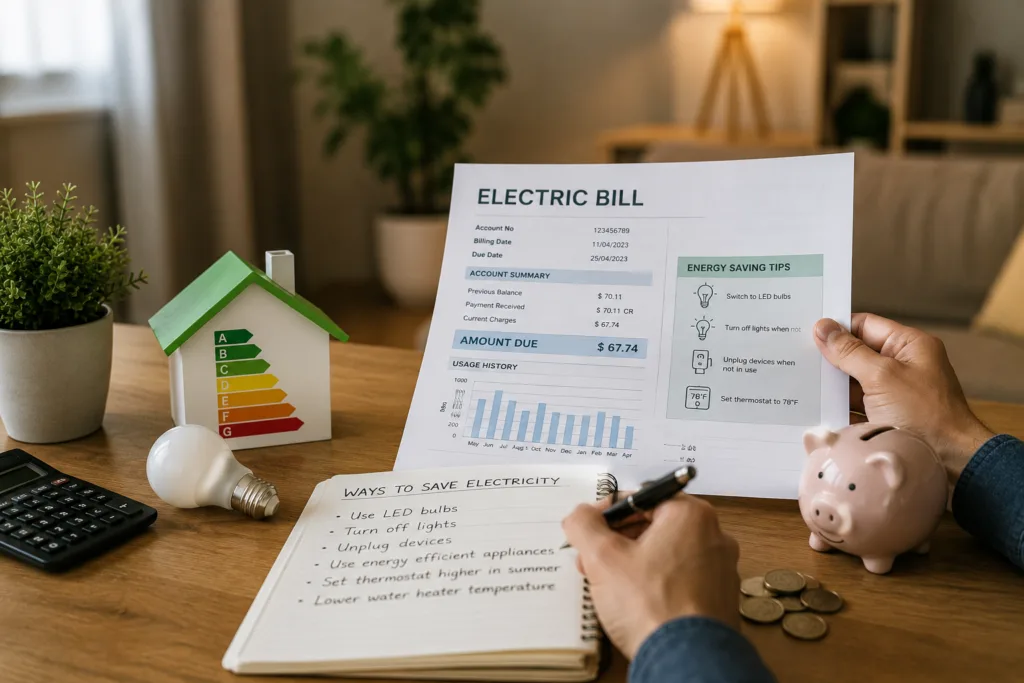
Your electric bill is one of the few household expenses that keeps going up whether you use more energy or not. Electricity prices have climbed steadily for years, and according to Savings Grove’s 2026 analysis, the average US household now spends over $1,500 per year on electric bills alone — and that number keeps rising.
The good news is that a significant chunk of that $1,500 is waste — phantom loads from idle electronics, inefficient appliances running on old settings, and habits that made sense before electricity costs spiked.
This guide gives you 15 proven ways to cut your electric bill in 2026. They’re organized from zero-cost changes you can make today to smart investments that pay for themselves over time. Whether you rent or own, live in a studio or a four-bedroom house, there are real savings here for you.
Why Your Electric Bill Is So High in 2026
Before fixing the problem, it helps to understand what’s actually driving it.
According to EcoFlow’s 2026 energy guide, heating and cooling systems account for nearly half of the average utility bill — more than any other category. After that, water heaters, lighting, and “phantom loads” from electronics that stay plugged in around the clock are the next biggest contributors.
The most impactful savings come from addressing these three areas first, not from small behavioral tweaks that feel meaningful but barely move the needle.
Here’s the full breakdown of where your electricity goes in a typical American home:
| Energy Use | Share of Bill |
|---|---|
| Heating and cooling (HVAC) | ~46% |
| Water heating | ~14% |
| Appliances and electronics | ~13% |
| Lighting | ~9% |
| Other | ~18% |
That breakdown tells you where to focus your attention. Let’s get into the 15 strategies.
Zero-Cost Changes — Start Today
1. Adjust Your Thermostat Settings
This is the single highest-impact zero-cost change you can make. The US Department of Energy recommends setting your thermostat to 78°F when you’re home in summer and 68°F in winter — and adjusting further when you’re asleep or away.
Every degree you raise your cooling setpoint in summer saves approximately 3% on your cooling bill. Going from 72°F to 78°F can cut your cooling costs by 15–18% with no equipment changes and no comfort sacrifice once your body adjusts.
If you don’t already have a programmable or smart thermostat, setting manual schedules — cooler at night, warmer when away — achieves the same result.
2. Eliminate Phantom Loads (Standby Power)
Here’s something most Americans don’t realize: electronics that are turned off but still plugged in continue drawing power. TVs, gaming consoles, phone chargers, microwaves, and cable boxes all consume electricity 24 hours a day even when you’re not using them.
According to Breaking AC’s 2026 electricity guide, phantom loads from idle electronics that stay plugged in around the clock are one of the most significant hidden contributors to monthly electric bills. The fix is simple: unplug devices you don’t use daily, or use smart power strips that cut power automatically when devices go to standby.
Eliminating phantom loads in a typical American home saves $100–$200 per year — with zero investment.
3. Wash Clothes in Cold Water
About 90% of the energy your washing machine uses goes toward heating the water — not running the machine itself. Switching from hot to cold water washes costs you nothing and saves the electricity equivalent of boiling roughly 30 kettles per load.
Modern detergents are formulated to clean effectively in cold water. Most loads — everyday clothes, towels, bedding — don’t need hot water at all. Reserve hot water for genuinely soiled items or sanitizing situations.
4. Run Full Loads Only — Dishwasher and Washer
A dishwasher uses roughly the same energy whether it’s washing 4 plates or 12. Same principle applies to your washing machine. Running half loads doubles the energy cost per item cleaned.
Wait until both appliances are full before running them. This one habit change alone can reduce your washer and dishwasher energy use by 30–50%.
5. Switch to LED Bulbs Everywhere
If you still have any incandescent or CFL bulbs in your home, replacing them with LEDs is one of the fastest-payback investments you can make. LED bulbs use up to 75% less energy than incandescent bulbs and last up to 25 times longer, according to the Department of Energy’s own published data.
A single LED bulb replacing an incandescent saves roughly $4–$6 per year. Replace 20 bulbs and you’re saving $80–$120 annually. A pack of LED bulbs costs $8–$15 at any hardware store, giving you full payback in under two months.
6. Adjust Your Water Heater Temperature
Most water heaters come from the factory set to 140°F. The Department of Energy recommends 120°F for most households — hot enough for all normal uses, but using 4–22% less energy depending on your household’s hot water demand.
Turn your water heater down to 120°F right now. It takes 30 seconds with a screwdriver on most traditional tank heaters, and you’ll never notice the difference in your shower or dishes.
7. Use Appliances During Off-Peak Hours
Many utility companies charge higher rates during peak demand hours — typically 4 PM to 9 PM on weekdays. Running your dishwasher, washing machine, and dryer after 9 PM or before noon can reduce your bill if your utility uses time-of-use pricing.
Check your utility’s rate structure online or call them to ask if you’re on a time-of-use plan or if you can switch to one. Shifting just two or three appliance loads per week to off-peak hours can save $5–$15 per month — roughly $60–$180 per year.
Low-Cost Upgrades — Under $50
8. Seal Air Leaks Around Windows and Doors
Heating and cooling your home is expensive. Heating and cooling the outside is a waste of money. Air leaks around windows, doors, and electrical outlets allow conditioned air to escape continuously — meaning your HVAC system works harder and longer to maintain your target temperature.
According to EcoFlow’s 2026 energy efficiency analysis, sealing air leaks and adding insulation can reduce heating and cooling costs by 10–20% — one of the highest-return improvements available to homeowners and renters alike.
Weatherstripping tape costs $5–$15 and takes an afternoon to install around doors and windows. Door draft stoppers cost $8–$20. Window insulation film kits cost $10–$25. Combined investment: under $50. Annual savings potential: $150–$300 depending on your climate and current leakage.
9. Install a Smart or Programmable Thermostat
If you don’t already have one, a programmable thermostat is one of the best investments you can make for long-term electricity savings. Smart thermostats like Ecobee or Google Nest learn your schedule, adjust automatically when you leave and return, and can be controlled from your phone.
Ecobee’s own data shows average savings of 26% on heating and cooling costs compared to keeping a fixed thermostat setting. At the national average electricity cost, that translates to $200–$400 in annual savings for a typical home — far more than the $50–$150 cost of the thermostat itself.
10. Use Smart Power Strips
Smart power strips go beyond regular power strips by detecting when your main device (a TV, for example) goes to standby and automatically cutting power to all connected peripherals — the cable box, game console, and speakers that would otherwise run on phantom load all night.
A good smart power strip costs $20–$35 and can eliminate $50–$150 per year in phantom load costs depending on how many devices are in your entertainment or home office setup.
Bigger Investments — High Long-Term Return
11. Get a Free Home Energy Audit
Before spending money on upgrades, get a professional energy audit to identify exactly where your home is losing energy. According to Savings Grove’s 2026 guide, professional audits typically cost $100–$400, but many utilities offer them free or at a steep discount — and addressing audit findings can reduce energy bills by 5–30%.
Call your utility company and ask specifically about free energy audit programs. Most major US utility providers offer them. An audit tells you which improvements will deliver the most savings for your specific home — so you’re not guessing.
12. Upgrade to Energy Star Appliances When Replacing
When any major appliance reaches the end of its life — refrigerator, dishwasher, washing machine, dryer — replace it with an Energy Star certified model rather than the cheapest available option.
Energy Star refrigerators use 9–10% less energy than standard models. Energy Star washers use 25% less energy and 33% less water. Over a 10–15 year appliance lifespan, the energy savings typically exceed the price premium by a significant margin.
The key word is “when replacing” — this is not a reason to throw out a working appliance. But when something breaks, the energy-efficient replacement pays for itself over time.
13. Consider a Smart Water Heater or Heat Pump Water Heater
Water heating is 14% of your electric bill. Heat pump water heaters — which pull heat from surrounding air rather than generating it directly — use 2–3 times less electricity than traditional electric resistance water heaters.
The upfront cost is higher ($800–$1,500 installed), but federal tax credits under the Inflation Reduction Act currently cover 30% of the installation cost, and annual energy savings of $300–$500 produce full payback within 2–4 years. Check EnergyStar.gov for current incentive programs in your state.
14. Explore Community Solar Programs
If you rent or don’t have the right roof for solar panels, community solar lets you subscribe to a share of a local solar farm and receive credits on your monthly electricity bill — typically saving 5–15% on the electricity portion of your charges.
According to Breaking AC’s 2026 electricity guide, community solar programs let you benefit from solar-generated electricity without installing panels — and most programs have no upfront cost and flexible cancellation terms. Search your zip code on EnergySage.com to find community solar programs available in your area.
15. Check if You Qualify for Utility Assistance Programs
This one is often overlooked: millions of Americans qualify for government and utility-funded programs that directly reduce energy costs — and most people don’t know they exist.
The Low Income Home Energy Assistance Program (LIHEAP) is a federal program that helps low-income households pay heating and cooling bills. In 2026, LIHEAP has a total budget of over $4 billion. According to the US Department of Health and Human Services, LIHEAP assistance is available in every state and can cover a significant portion of heating and cooling costs for qualifying households.
Income limits vary by state, but a household of four earning up to $55,000 per year may qualify in many states. Visit needhelppayingbills.com or call 211 to find programs available in your area.
Additionally, many utility companies offer their own bill assistance programs, budget billing plans that smooth out seasonal spikes, and free efficiency upgrades — including free insulation, LED bulbs, and low-flow showerheads — for income-qualifying customers. Call your utility directly and ask what assistance programs are available.
Building Your Savings Into a Real Financial Foundation
Cutting your electric bill by even $100 per month generates $1,200 per year — money that can completely change your financial situation if you use it intentionally.
The most impactful thing you can do with utility savings is redirect them toward financial goals rather than absorbing them into general spending. If you’re currently living paycheck to paycheck with no financial cushion, our complete guide on why 37% of Americans still can’t cover a $400 emergency explains exactly how to use small monthly savings to build the financial buffer that protects you when real emergencies hit.
And if your financial goal is eliminating debt, our step-by-step breakdown of how to pay off $23,000 in debt using the debt snowball method shows how an extra $100–$200 per month — exactly what these energy savings can generate — becomes a genuinely life-changing amount when applied consistently to debt payoff.
Small monthly savings, redirected with intention, compound into major financial progress. Lowering your electric bill is a practical first step in that direction.
Quick Reference: All 15 Ways to Lower Your Electric Bill
| Strategy | Cost | Annual Savings Potential |
|---|---|---|
| Adjust thermostat settings | Free | $150–$300 |
| Eliminate phantom loads | Free | $100–$200 |
| Wash in cold water | Free | $40–$80 |
| Run full loads only | Free | $30–$60 |
| Switch to LED bulbs | $8–$15 | $80–$120 |
| Lower water heater to 120°F | Free | $30–$80 |
| Use off-peak hours | Free | $60–$180 |
| Seal air leaks | $20–$50 | $150–$300 |
| Smart/programmable thermostat | $50–$150 | $200–$400 |
| Smart power strips | $20–$35 | $50–$150 |
| Free home energy audit | Free (via utility) | Varies widely |
| Energy Star appliances (on replacement) | Price premium | $50–$200/yr |
| Heat pump water heater | $800–$1,500 | $300–$500 |
| Community solar subscription | Free to join | 5–15% on electric portion |
| Utility assistance programs | Free to apply | Varies by program |
FAQ
Q1: What is the fastest way to lower your electric bill right now? A1: The fastest zero-cost changes are adjusting your thermostat settings, unplugging electronics you’re not using, switching laundry to cold water, and waiting to run full loads in your dishwasher and washing machine. These changes combined can reduce your bill by $20–$50 in the first month with no investment.
Q2: How much does the average American pay for electricity in 2026? A2: According to 2026 data from Savings Grove and Electric Choice, the average US household now spends over $1,500 per year on electricity — roughly $125 per month. Costs vary significantly by state, with Southern states typically paying more due to air conditioning demand.
Q3: Does unplugging electronics really save money? A3: Yes — significantly. Electronics on standby mode draw continuous power known as phantom loads. According to energy experts, eliminating phantom loads in a typical American home can save $100–$200 per year with zero investment beyond the habit change or a $20–$35 smart power strip.
Q4: What appliances use the most electricity in a home? A4: Heating and cooling (HVAC) accounts for about 46% of the average electric bill — far more than anything else. Water heaters use about 14%, appliances and electronics about 13%, and lighting about 9%. Targeting your thermostat and hot water settings delivers the most savings.
Q5: Can renters lower their electric bills or only homeowners? A5: Renters have significant options. Zero-cost habit changes (thermostat, cold water laundry, phantom loads), LED bulb swaps, door draft stoppers, window weatherstripping, and community solar subscriptions are all available to renters without landlord permission. Renters can also apply for LIHEAP and utility assistance programs independently of their landlord.
DISCLAIMER
The savings estimates in this article are based on published data from the Department of Energy, utility industry sources, and 2026 energy guides. Individual savings will vary based on home size, climate, current energy use, and utility rates. Always verify current program availability and incentives directly with your utility provider.

Mohammad Javed is the founder and personal finance writer behind FinanceBeliever.com. He holds a Master of Commerce (MCom) degree with a specialization in finance and financial markets. Through years of personal experience studying credit systems, debt management, investment strategies, and how everyday financial decisions impact real households, he built Finance Believer to deliver straight, research-backed financial guidance to American readers. Every article he writes is sourced from authoritative data — including the Federal Reserve, the Consumer Financial Protection Bureau, and the Bureau of Labor Statistics. His work covers credit scores, loans, banking, insurance, investing, and personal budgeting — all written in plain English without the jargon.