
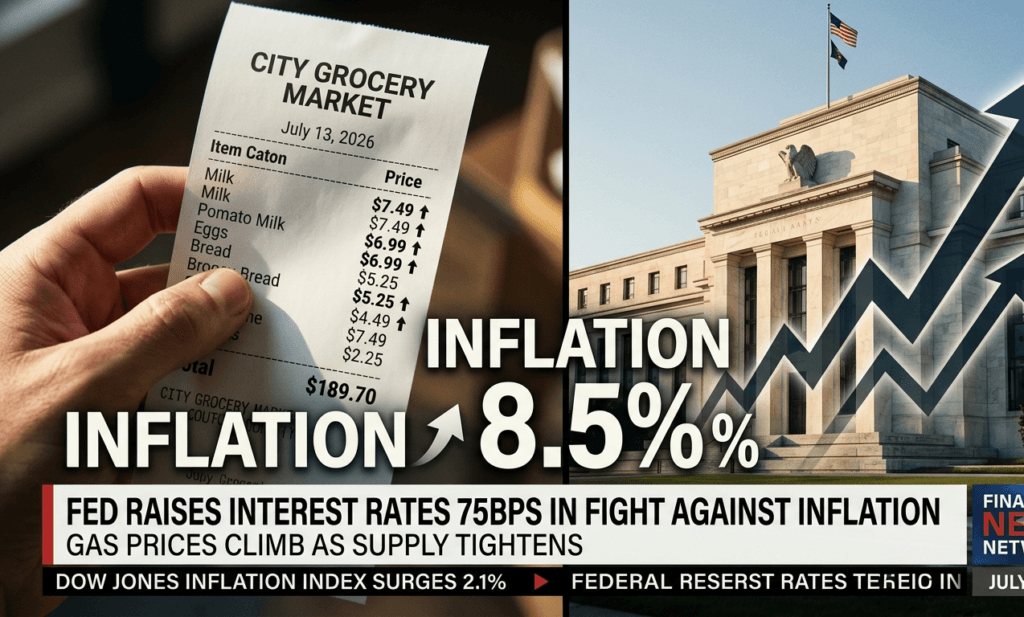
The June CPI report for July 2026 releases this morning at 8:30 AM Eastern Time — and it may be the most important inflation number Americans see all year.
If you’ve been watching grocery prices creep higher, wondering why your savings account yield isn’t keeping up, or nervously watching mortgage rates — this report directly affects all of it. The May inflation report came in at 4.2% year-over-year, the hottest reading since April 2023. The question for today: is inflation genuinely cooling, or are we about to get fooled by a temporary blip in energy prices?
The honest answer is that today’s headline number will almost certainly look better than May’s — and economists are warning you not to believe it.
What the Numbers Are Expected to Show
Here’s what Wall Street is forecasting before the 8:30 AM release.
Barclays economist Pooja Sriram, quoted by SavingAdvice, is forecasting headline CPI of 3.8% year-over-year for June — down from May’s blistering 4.2%. Sriram attributes the projected cooling to the temporary dip in crude oil prices that occurred after the US-Iran ceasefire was signed on June 17. “This reflects the dip in crude oil prices after the US-Iran peace deal was signed in mid-June,” Sriram noted.
BMO Chief Economist Douglas Porter, quoted by Kiplinger’s CPI preview, goes even further — forecasting headline CPI to actually decline 0.1% month-over-month in June. “Pump prices fell 10% in June — the fourth largest monthly decline in the past decade,” Porter writes. “There’s not much of a seasonal adjustment in June gasoline prices, so that alone will carve 4 ticks from overall prices.”
On the surface, that sounds like great news: inflation cooling, maybe even going negative for the month. Don’t get too comfortable.
Why Today’s Headline Is a Head-Fake
Here is the critical context that most Americans miss when inflation reports come out.
The Federal Reserve doesn’t set interest rates based on headline CPI. It focuses on core CPI — inflation with food and energy prices stripped out. The reason: food and energy prices are volatile. They spike when there’s a war in the Middle East, then drop when there’s a ceasefire. That volatility doesn’t tell the Fed whether the underlying economy is generating sustained inflation — and sustained inflation is what the Fed actually tries to control.
According to Finance Calendar’s detailed July 14 CPI preview, core CPI — which excludes food and energy — is expected to rise 0.3% month-over-month in June, keeping the annual core rate steady at approximately 2.9%. That’s not cooling. That’s sticky, persistent inflation that has barely budged for 12 months.
BMO’s Porter says it clearly: “Core prices are expected to grind up another 0.3%, keeping the annual core trend steady at 2.9% — precisely where core CPI inflation stood a year ago.”
This means: the headline number will look better, the media will report that inflation is easing, and the underlying inflation pressure that the Fed actually fights will remain exactly as stubborn as it was in May.
What the Fed Did Last Month — And What It Signals for Rates
The June CPI report doesn’t exist in a vacuum. It arrives in the middle of a dramatic shift in Federal Reserve policy.
In May, the CPI shocked markets with a 4.2% annual reading — the hottest since April 2023. According to Kiplinger’s analysis, that reading was enough to force the Fed’s hand at its June FOMC meeting — the first with new Chairman Kevin Warsh at the helm. The Fed bumped its median 2026 inflation forecast from 2.7% to 3.6% and raised its median rate projection from 3.4% to 3.8%, signaling that rates will be staying higher for longer.
Translation: the Fed is now preparing to hike rates — not cut them. Futures markets currently price in a 61% chance of a September rate hike, according to the CME FedWatch Tool.
If today’s June CPI core reading comes in above expectations — say, 0.4% instead of the expected 0.3% — that probability jumps sharply. If it comes in below, there’s a brief moment of relief. But with oil spiking 4% this very morning due to renewed US-Iran strikes on the Strait of Hormuz (we covered this in detail in our oil prices spike analysis from today), any June respite in energy prices looks very temporary.
What High Inflation Actually Means for Your Wallet
Let’s translate these percentages into real money.
Groceries: The BLS official May 2026 CPI report shows food prices rose 0.2% in May alone, with food away from home up 0.3% and food at home up 0.1%. At 4.2% annual inflation, a family spending $1,000/month on groceries in July 2025 is spending roughly $1,042 today just to buy the same things. That $42/month extra — $504/year — adds up fast, especially for families already stretched thin.
Housing: Shelter costs — rent and the equivalent cost of owning — make up about one-third of the entire CPI basket. According to Finance Calendar’s CPI breakdown, shelter has been the most persistent source of above-target inflation in the current cycle. Even if energy prices fall, housing costs are keeping core inflation elevated.
Mortgage rates: Here’s where it gets painful for would-be homebuyers. The 30-year fixed mortgage rate tracks closely with the 10-year Treasury yield, which in turn responds to Fed rate expectations. With the Fed signaling a potential September hike, mortgage rates have stayed elevated. If today’s CPI prints hot — especially on core — expect rates to drift even higher. If you’ve been waiting for rates to fall before buying a home, a hawkish Fed keeps that wait longer. Our guide on how to get a mortgage with bad credit in 2026 covers the full landscape of what lenders are looking at right now.
Savings accounts: This is the one area where higher inflation — and a potential Fed hike — actually helps savers. If the Fed raises rates in September, high-yield savings accounts and money market accounts will likely see their APYs bump up. Currently the best high-yield accounts are paying around 4.5–5.0% APY. A rate hike could push that above 5%. That’s real money on a $10,000 or $20,000 emergency fund.
Your 401(k): A hot inflation print sends stocks lower in the short term because it raises rate hike probability, which raises the discount rate on future earnings, which lowers stock valuations. But the relationship isn’t permanent — the S&P 500 has delivered positive real returns even through periods of significant inflation. If you’re a long-term investor, today’s CPI report shouldn’t change your investment strategy. Understanding the difference between a Roth IRA and 401(k) in 2026 matters more for your long-term outcome than any single monthly inflation reading.
The Social Security COLA Connection — Why Retirees Are Watching This Report Closely
There’s another group watching today’s number with particular attention: the approximately 70 million Americans who receive Social Security benefits.
As SavingAdvice’s retiree guide explains, the Social Security Administration calculates the annual Cost of Living Adjustment (COLA) using the average CPI-W during July, August, and September, compared with the same period one year earlier. June’s reading is a preview — not the deciding factor — but it sets expectations.
If inflation stays elevated through July, August, and September, the 2027 Social Security COLA will be meaningfully higher than recent years. That sounds good for retirees — higher checks — but it also signals that prices are eating into purchasing power faster than the adjustment can keep up.
This CPI report is also particularly significant given the Social Security trust fund crisis we’ve documented in detail. The program is projected to face a 22% benefit cut by 2032 unless Congress acts. An inflation environment that forces the Fed to hike rates slows economic growth and reduces the payroll tax revenue that funds Social Security — making the math worse, not better. If you haven’t read our breakdown of what the Social Security cuts mean for your retirement, today is a good day to do that.
How to Read the CPI Report This Morning
The Bureau of Labor Statistics releases the data at exactly 8:30 AM ET. Here’s what to look at and in what order:
First: the month-over-month headline number. This is what the media will lead with. Expect something around -0.1% to +0.1%. If it’s negative, don’t celebrate — that’s the energy price drop talking.
Second: the year-over-year headline number. Expected around 3.8-3.9%. This is down from May’s 4.2% but still well above the Fed’s 2% target. Context matters.
Third — and most important: the core CPI month-over-month. This is what the Fed actually watches. Expected 0.3%. If this comes in at 0.4% or higher, markets will reprice for faster Fed rate hikes, and you’ll see stocks sell off and bond yields jump within minutes.
Fourth: shelter and services inflation. Look at the shelter component specifically. If it shows any sign of cooling, that’s genuinely good news for the long-term inflation outlook. If it stays hot, the Fed’s problem is structural, not just energy-related.
The US Bureau of Labor Statistics official CPI page at bls.gov/cpi will have the full release at 8:30 AM ET. The initial market reaction in S&P 500 and Treasury futures will be visible within seconds.
What Happens After the Report — The Rest of Today’s Schedule
Today is one of the most data-dense days of the year. Here’s everything happening July 14:
8:30 AM ET — June CPI report (headline and core inflation) Morning — JPMorgan Chase, Goldman Sachs, Wells Fargo, Citigroup, Bank of America all report Q2 earnings before the open 10:00 AM ET — Fed Chairman Kevin Warsh begins semi-annual Congressional testimony
The interaction between these three events is what makes today so significant. If CPI prints hot, Warsh’s testimony will face immediate questions about rate hikes. If bank earnings disappoint alongside a hot inflation print, stocks could see a sharp selloff. If CPI is softer than expected and banks beat earnings, you could see a significant rally.
The range of outcomes for markets today is unusually wide — which itself is worth knowing before you check your portfolio this morning.
What You Should (and Shouldn’t) Do Right Now
Do: Check the 8:30 AM CPI release and note the core CPI number specifically. That’s the real signal.
Do: If you have cash sitting in a regular savings account earning 0.5% or less, move it to a high-yield savings account now — regardless of what CPI shows. Rates are elevated either way.
Do: If you’re planning to buy a home in the next 6-12 months, get pre-approved now while rates are where they are. Waiting for rates to fall could mean waiting another year or more if the Fed hikes in September.
Don’t: Make dramatic changes to your investment portfolio based on one month’s inflation report. Long-term investors have weathered far worse inflation environments than 4.2%.
Don’t: Confuse a negative headline CPI reading with “inflation is over.” The Fed won’t be fooled, and neither should you.
Frequently Asked Questions
When does the June 2026 CPI inflation report release? The Bureau of Labor Statistics releases the June 2026 CPI report on Tuesday, July 14, 2026 at exactly 8:30 AM Eastern Time. The full report is available immediately at bls.gov/cpi. Major financial news outlets including CNBC, Bloomberg, and the Wall Street Journal will have instant analysis and market reaction within minutes.
What is the expected June 2026 CPI inflation number? Economists are forecasting headline CPI to come in around 3.8-3.9% year-over-year, down from May’s 4.2%. Month-over-month, BMO forecasts a -0.1% reading due to the drop in gasoline prices in June following the brief US-Iran ceasefire. Core CPI — excluding food and energy — is expected at 0.3% month-over-month, holding the annual core rate around 2.9%.
How does the CPI report affect my mortgage rate? The CPI report influences mortgage rates indirectly through its effect on Federal Reserve rate expectations and 10-year Treasury yields. A hotter-than-expected core CPI print raises the probability of a September Fed rate hike, which pushes Treasury yields higher and mortgage rates follow. A cooler core print gives brief relief but doesn’t change the long-term rate outlook significantly.
Will today’s CPI affect Social Security payments? The June CPI is a preview, not the deciding factor. Social Security’s 2027 COLA adjustment is calculated using the average CPI-W during July, August, and September 2026 compared with the same period in 2025. If inflation stays elevated through those three months, the 2027 COLA will be higher — which means larger checks but also signals purchasing power is being eroded.
What does core CPI mean and why does it matter more than headline CPI? Core CPI strips out food and energy prices — the two most volatile components of the inflation basket — to show the underlying trend in prices. The Federal Reserve focuses on core inflation when setting interest rates because it reflects demand-driven inflation that monetary policy can actually influence. Headline CPI swings up and down with oil prices, but core CPI reveals whether inflation is genuinely cooling or just temporarily masked by cheap gas.
This article is for informational purposes only and reflects expectations ahead of the July 14, 2026 CPI release. Actual results may differ from forecasts. This does not constitute financial or investment advice. Always consult a qualified financial advisor before making decisions based on economic data.

Mohammad Javed is the founder and personal finance writer behind FinanceBeliever.com. He holds a Master of Commerce (MCom) degree with a specialization in finance and financial markets. Through years of personal experience studying credit systems, debt management, investment strategies, and how everyday financial decisions impact real households, he built Finance Believer to deliver straight, research-backed financial guidance to American readers. Every article he writes is sourced from authoritative data — including the Federal Reserve, the Consumer Financial Protection Bureau, and the Bureau of Labor Statistics. His work covers credit scores, loans, banking, insurance, investing, and personal budgeting — all written in plain English without the jargon.