
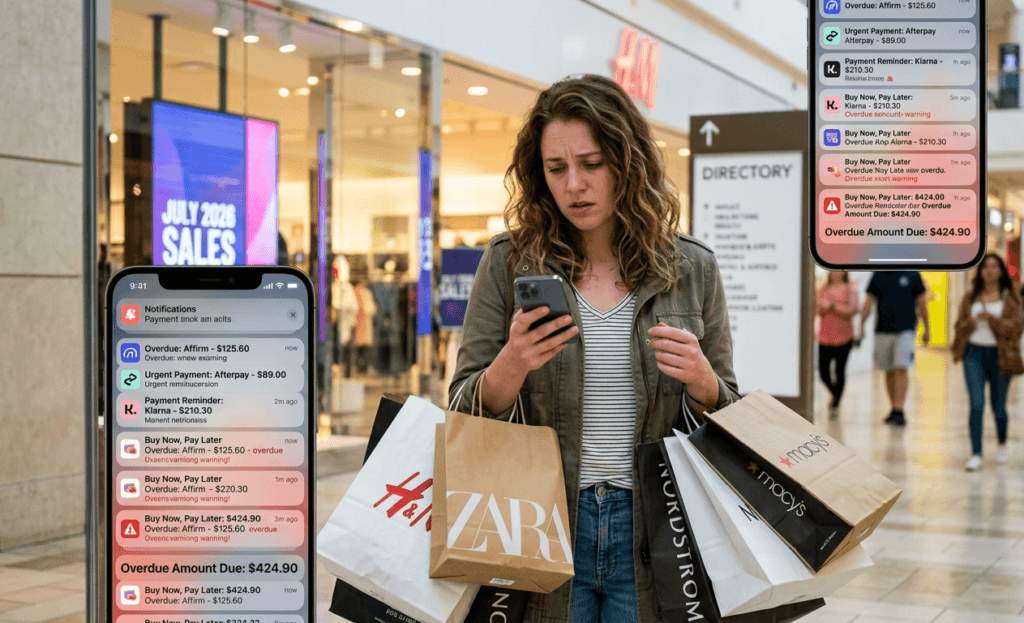
Buy now pay later dangers in 2026 are something most Americans discover the hard way — after they’ve already clicked “pay in 4” dozens of times and suddenly can’t figure out where their money went.
Here’s the setup: you’re checking out online. The total is $180 for something you need — or really want. Then you see it. “Pay in 4 interest-free installments of $45.” That sounds completely manageable. You click it. You get the item. Life is good.
But according to a new Gallup poll published in May 2026, 51% of Americans have now used installment plans for online purchases, and 27% use them frequently or occasionally. The people using BNPL most heavily are lower-income households — exactly the group that can least afford the consequences when things go wrong.
And things go wrong more often than anyone admits.
What Buy Now Pay Later Actually Is
Before getting into the dangers, it’s worth understanding what you’re actually agreeing to when you click that button.
Buy Now Pay Later (BNPL) services — including Klarna, Afterpay, Affirm, and similar platforms — are short-term financing products that let you split a purchase into installments, typically 4 payments spread over 6 weeks. The “pay in 4” model is usually interest-free if you make all payments on time.
That’s the pitch. Here’s what’s in the fine print.
Danger 1: Late Fees That Appear From Nowhere
The “interest-free” promise has a catch: it only applies if every payment arrives on time. Miss one payment and the fees kick in fast.
According to NerdWallet’s 2026 BNPL fee analysis, Afterpay charges a $10 late fee on the first missed payment, then an additional $7 if it’s still unpaid after 7 days — capped at 25% of the order value. Klarna charges a flat $7 late fee. Affirm’s fees vary by loan type and can include interest charges as high as 36% APR on longer-term plans.
On a $200 purchase, a single missed payment on Afterpay costs you $17 in fees — turning your “free” split payment into a 34% annualized cost if you think about it that way. The math stops looking so friendly.
Danger 2: You Can Lose Track of What You Owe — Fast
This is the most underreported danger of BNPL. It’s not one purchase — it’s the accumulation.
Think about how this works in practice. You use Afterpay for a $120 clothing order. Then Klarna for a $95 kitchen item. Then Affirm for a $340 electronics purchase. None of these feel like “debt” in the traditional sense. There’s no single credit card statement showing you the damage. Each payment comes out of your account on different dates, from different platforms, in different amounts.
Forbes Advisor’s BNPL debt analysis found that the average BNPL user has 3–4 active plans running simultaneously. At that level, you could easily have $200–$400 in automatic withdrawals hitting your bank account every two weeks — from purchases that felt small in the moment but compound into a meaningful ongoing obligation.
This is how BNPL creates what researchers call “debt invisibility” — you feel financially okay because you haven’t charged anything to a credit card, but your checking account is being drained by installment payments you can’t easily track in one place.
Danger 3: The Credit Score Impact Most People Miss
Here’s where it gets complicated — and where most BNPL users are completely uninformed.
The credit score impact of BNPL depends entirely on which service you use and what type of plan you choose. According to Experian’s 2026 BNPL credit reporting guide, the situation breaks down like this:
“Pay in 4” plans (the most common short-term split payment) are generally NOT reported to the major credit bureaus by most BNPL providers. This means they won’t help build your credit — but a single late payment won’t necessarily hurt it either. The risk here is mostly the fees and debt accumulation.
Longer-term BNPL loans (Affirm’s 6, 12, or 24-month financing options, for example) ARE typically reported to credit bureaus. This means late payments or defaults on these plans directly damage your credit score — sometimes significantly.
The hard inquiry problem: Some BNPL lenders run a hard credit check when you apply, which temporarily lowers your credit score by 5-10 points. If you’re applying for multiple BNPL accounts across different platforms in a short period, those hard inquiries add up.
The utilization problem: When BNPL debt does get reported to credit bureaus, it can affect your credit utilization ratio — the percentage of available credit you’re using. High utilization is the second-biggest factor in your credit score after payment history. If you’re planning to apply for a mortgage, car loan, or personal loan in the next 6-12 months, this matters a great deal. Our guide on what credit score you need to buy a house in 2026 explains exactly how these factors interact.
Danger 4: It Makes Overspending Psychologically Easier
This one is backed by research and it’s the most honest danger to discuss.
BNPL is specifically designed to reduce what behavioral economists call “purchase pain” — the discomfort of seeing a large number leave your account at once. When a $400 purchase becomes “$100 today,” your brain doesn’t register the full cost in the same way. This isn’t a coincidence. It’s the product design.
A 2026 study published in the Journal of Consumer Psychology found that shoppers using BNPL spent an average of 15-20% more per transaction than those paying with a debit card or credit card in full. They also purchased more frequently. The installment structure doesn’t just make individual purchases easier — it increases total spending across sessions.
According to Bankrate’s 2026 BNPL consumer survey, 38% of BNPL users have spent more than they should have using these services, and 34% have used BNPL specifically for purchases they couldn’t otherwise afford. Those aren’t fringe users making poor decisions — they’re the statistical center of the BNPL customer base.
Danger 5: Collections and the Debt Spiral
This is where BNPL goes from inconvenient to genuinely damaging.
If you miss multiple payments and a BNPL account goes to collections, the consequences shift dramatically. A collection account can drop your credit score by 50-100+ points and remain on your credit report for up to seven years.
Consumer Reports’ 2026 BNPL investigation found that BNPL companies are increasingly selling unpaid debt to third-party collection agencies — the same aggressive collectors who pursue medical debt and credit card defaults. This means a $45 missed payment on a clothing order can eventually turn into a collection notice, credit damage, and potential legal action.
The Consumer Financial Protection Bureau’s 2024 BNPL report — still the governing regulatory analysis in 2026 — found that BNPL users are significantly more likely to be financially distressed than non-users, and that BNPL use correlates strongly with high credit card utilization, overdrafts, and payday loan use. In other words, BNPL isn’t typically being used by financially stable people as a convenient tool. It’s being used disproportionately by people who are already financially stretched — and it’s making their situation worse, not better.
Who Is Most at Risk
Not everyone who uses BNPL ends up in trouble. The risks are highest for:
Lower-income households. The Gallup data shows that 37% of lower-income households use BNPL frequently or occasionally, versus 21% of higher-income households. Lower-income users have less financial buffer when auto-payments hit unexpectedly.
Younger consumers — especially Gen Z. According to Morning Consult’s 2026 BNPL research, Gen Z users are significantly more likely to use multiple BNPL platforms simultaneously and significantly less likely to read the terms before signing up.
People already carrying high-interest debt. Using BNPL while carrying credit card balances creates competing payment obligations. If your checking account is already stretched thin by credit card minimum payments, adding BNPL auto-debits creates a higher risk of overdrafts and cascade missed payments. Our guide on the best balance transfer credit cards in 2026 covers how to consolidate and reduce existing high-interest debt before adding any new payment obligations.
How To Use BNPL Without Getting Burned
BNPL isn’t inherently evil — it’s a tool that can work well under the right conditions. Here’s how to use it safely:
Rule 1: Only use BNPL for planned purchases you were already going to make. If you wouldn’t have bought it without the installment option, don’t buy it. This single rule eliminates the overspending trap.
Rule 2: Never run more than one BNPL plan at a time. Track your active BNPL obligations the same way you’d track a credit card balance. If you can’t name every active plan and every upcoming payment date off the top of your head, you have too many running simultaneously.
Rule 3: Make sure each installment payment fits comfortably in your budget. Use the 50/30/20 rule — BNPL payments should come out of your “needs” or “wants” budget, not by squeezing your savings. Our detailed guide on how to budget your money using the 50/30/20 rule helps you figure out exactly where BNPL payments fit.
Rule 4: Set payment reminders. Most BNPL apps have notification settings — turn them all on. A $7 late fee on a $50 installment is a 14% penalty for forgetting a payment date.
Rule 5: Read what gets reported to credit bureaus. Before using any BNPL service, check their credit reporting policy. If you’re planning a major credit application (mortgage, car loan) in the next 6-12 months, stick to “pay in 4” plans that don’t report to credit bureaus — and even then, keep balances minimal.
Frequently Asked Questions
Does Buy Now Pay Later affect your credit score? It depends on the plan and provider. Short-term “pay in 4” plans are typically not reported to major credit bureaus, so they don’t directly affect your score — but late payments may still go to collections if severely delinquent. Longer-term BNPL financing (6-24 months) is usually reported to credit bureaus, meaning late payments directly damage your credit score. Always check the specific provider’s credit reporting policy before using.
What happens if you miss a Buy Now Pay Later payment? You’ll typically be charged a late fee ($7-$10 depending on the provider), which compounds if the payment remains unpaid. Repeated missed payments can result in your account being sent to a collections agency, which damages your credit score and stays on your credit report for up to seven years. Some providers also restrict your ability to make future BNPL purchases until the balance is settled.
Is Buy Now Pay Later the same as a credit card? No — but they share some risks. BNPL doesn’t require a credit card and often doesn’t require a hard credit check for short-term plans. Unlike credit cards, BNPL doesn’t help you build credit history in most cases. Credit cards offer stronger consumer protections, including dispute rights under the Fair Credit Billing Act, which most BNPL purchases don’t have.
Which Buy Now Pay Later services are safest to use? All major BNPL services carry the same core risks — late fees, debt accumulation, and potential collections. The “safest” use is sticking to one provider’s pay-in-4 plan for planned purchases you can comfortably afford, keeping only one active plan at a time, and setting payment reminders. No BNPL service is safe if used to buy things you can’t actually afford.
How many Americans are in debt because of Buy Now Pay Later? According to a 2026 Gallup poll, 51% of Americans have used BNPL installment plans, with 27% using them frequently or occasionally. Bankrate’s 2026 survey found that 38% of BNPL users have spent more than they should have using these services. The Consumer Financial Protection Bureau found that BNPL users are significantly more likely to show other signs of financial distress, including high credit card utilization and overdrafts.
This article is for informational purposes only and does not constitute financial or legal advice. Buy Now Pay Later terms, fees, and credit reporting policies vary by provider and change frequently. Always read the full terms before using any BNPL service.

Mohammad Javed is the founder and personal finance writer behind FinanceBeliever.com. He holds a Master of Commerce (MCom) degree with a specialization in finance and financial markets. Through years of personal experience studying credit systems, debt management, investment strategies, and how everyday financial decisions impact real households, he built Finance Believer to deliver straight, research-backed financial guidance to American readers. Every article he writes is sourced from authoritative data — including the Federal Reserve, the Consumer Financial Protection Bureau, and the Bureau of Labor Statistics. His work covers credit scores, loans, banking, insurance, investing, and personal budgeting — all written in plain English without the jargon.