
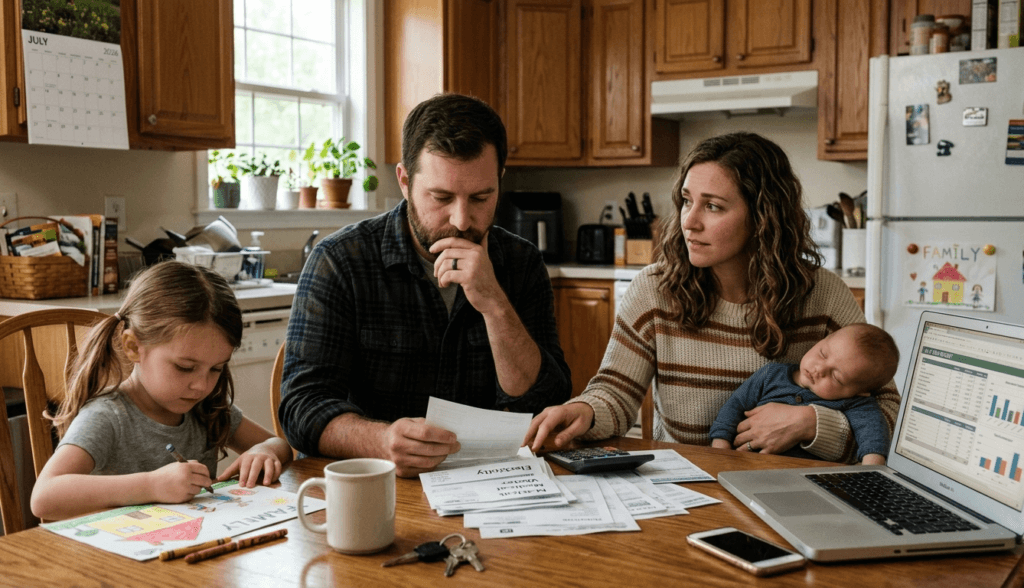
The cost of raising a child in America has reached a number that stops most parents mid-scroll: $303,418, from birth through age 18, even after accounting for available tax credits.
According to ABC News’ 2026 breakdown of the LendingTree report, that figure has jumped nearly 28% since 2023 — a shift certified financial planner Ashley Feinstein Gerstley described plainly: “Parents don’t need a report to tell them raising kids has gotten more expensive, because we have been living it. Families feel it most in housing, in childcare and at the grocery store.”
If you’re a parent right now, a prospective parent doing the math before deciding, or an adult watching a sibling or friend navigate this, the number is worth understanding in detail — not to cause panic, but because a real plan starts with a real number.
Where the $303,418 Actually Goes
According to the Foundation for Family and Youth Financial Empowerment’s 2026 analysis, that total works out to an average of $16,857 per year for a middle-income family — but the spending isn’t spread evenly across all 18 years. The first five years are by far the most expensive, costing families about $29,325 per year on average, largely driven by one specific expense category.
Childcare is the single biggest early-years expense. According to the same FFYF analysis, infant childcare alone averages $17,264 annually — making it one of the largest single line items families face, even larger than housing costs during those early years for many families. Even with a slight recent dip, childcare costs have surged 46.9% since 2021, far outpacing nearly every other category of child-rearing expense. Families are spending nearly 22% of their income on the basic costs of raising a young child, according to FFYF’s data.
Sarah Rittling, FFYF’s executive director, put it directly: “Child care costs stretch household budgets to the breaking point. When the early years of raising a child are also the most expensive, it puts enormous pressure on parents who are trying to work and support their families.”
According to ABC News’ reporting, food costs are compounding the pressure too. “Food prices jumped because it became more expensive to produce, package and transport groceries,” Gerstley explained. “Higher labor costs, supply chain disruptions and fuel prices all played a role.” If grocery bills feel heavier lately, our detailed guide on how to save money on groceries in 2026 covers specific, practical strategies that apply directly to this pressure point.
Why This Number Keeps Outpacing Wages
This isn’t simply inflation working evenly across the economy — child-rearing costs have specifically outpaced wage growth in a way that’s worth understanding.
According to IndexBox’s July 2026 analysis of the broader middle-class squeeze, the typical cost of raising a child grew 150% between 2000 and 2025 — from $165,630 to $414,000 in that particular calculation methodology — while wages increased only 112% over the same period. That gap means child-rearing costs have outpaced earnings growth by nearly 40 percentage points over a quarter century. This is happening alongside a broader shift: the same IndexBox analysis notes that in 1971, about 61% of Americans belonged to the middle class, but by 2023 that share had fallen to 51%, based on Pew Research analysis.
The housing connection matters here specifically. According to IndexBox’s data, the median U.S. single-family home price has more than doubled since 2012, rising to $357,275 from $164,000 in January 2026 — and housing consistently represents the single largest category of child-rearing costs, at roughly 29% of the total according to USDA’s cost-of-raising-a-child methodology, which remains the baseline framework most current estimates build from.
How Your State Changes the Math Dramatically
One of the most useful things about the 2026 data is how clearly it shows that “the cost of raising a child” isn’t one number — it varies enormously by where you actually live.
According to Fortune’s April 2026 coverage of the LendingTree state-by-state analysis, families in Hawaii face a total cost of more than $412,000 over 18 years — more than double the cost in some lower-cost states. States like Alaska, Maryland, California, and New Jersey aren’t far behind, all hovering around or above the $300,000 mark. On the other end, places like New Hampshire and Mississippi come in significantly lower, closer to $200,000 total.
The year-over-year change matters as much as the absolute number. Fortune’s reporting notes that in some states, costs are increasing much faster than the rate of inflation — Kansas and Alaska’s projected 18-year child-rearing costs jumped 23.5% between LendingTree’s 2025 and 2026 analyses, and Montana increased by 21.7%. Fourteen states saw the cost of raising a small child increase by at least 10% in just one year.
Childcare specifically drives much of this state-level variation. According to Fortune’s data, parents in Hawaii pay an average of $40,342 per year for childcare, whereas families in Maryland and Massachusetts pay $36,419 and $34,247, respectively — figures that would represent a significant portion of many American households’ entire annual income.
Even in the “lower cost” states, ABC News’ reporting notes, parents say the day-to-day experience still feels expensive. The gap between states is real, but so is the pressure everywhere.
What This Actually Means for Your Monthly Budget
Translating the 18-year total into monthly terms makes the number more concrete for actual planning purposes.
At $303,418 over 18 years, that averages to roughly $1,404 per month — but as covered above, that average masks a front-loaded reality where the early years cost significantly more, closer to $2,444 per month during the first five years according to FFYF’s $29,325 annual figure for that period.
For a middle-income family, this represents a substantial and non-negotiable portion of the household budget for nearly two decades. If you’re building or revisiting your family budget around these numbers, our detailed guide on how to budget money using the 50/30/20 rule provides a framework for fitting genuinely large, ongoing expenses like childcare into a sustainable monthly plan rather than treating them as a series of financial shocks.
Planning Ahead — What Actually Helps
Build your emergency fund before the child arrives, not after. The unpredictability of early parenthood — medical costs, unexpected childcare gaps, lost income during parental leave — makes a financial cushion more important during this specific life stage than almost any other. Our guide on building an emergency fund as an American in 2026 covers exactly how to build this systematically, even on a tight timeline.
Understand your health insurance and medical costs before delivery. Medical expenses around childbirth and early childhood can be substantial and unpredictable. If unexpected medical bills do arrive, our guide on how to negotiate medical bills down in 2026 covers real strategies that can meaningfully reduce what you actually owe.
Research childcare costs in your specific area well before you need care. Given how dramatically childcare costs vary by state and even by metro area within a state, getting real local quotes early — rather than relying on national averages — changes your planning accuracy significantly. Waitlists for quality childcare in many areas also run 6-12 months or longer, making early research a practical necessity, not just a financial one.
Consider whether your current housing situation still fits. Since housing represents the largest single category of child-rearing costs at roughly 29% of the total, and since space and location needs often shift meaningfully with a growing family, it’s worth running the numbers on your specific situation. If homeownership is part of your planning, our guide on how to buy a house with no money down in 2026 covers the federal programs that can make this more accessible.
Start any education savings early, even in small amounts. The $303,418 figure notably excludes college entirely. Starting a 529 plan or similar education savings vehicle with even modest monthly contributions in a child’s early years captures far more compound growth than waiting until they’re a teenager.
The Honest Reframe
These numbers can feel overwhelming presented all at once — and it’s worth saying clearly: nobody pays $303,418 in a single transaction. It’s distributed across 18 years, adjusted constantly by real family choices about childcare arrangements, housing, and lifestyle that this national average can’t capture for your specific situation.
What the data is genuinely useful for is removing the surprise factor. Families who understand roughly what’s coming — and specifically that the first five years carry a disproportionate share of the cost through childcare — can build a financial plan around that reality rather than being blindsided by it month to month. That’s the actual value of a number like this: not as a source of anxiety, but as a planning input for a decision most parents make with love first and math second, which is exactly as it should be — but math still helps.
Frequently Asked Questions
How much does it actually cost to raise a child in America in 2026? According to LendingTree’s 2026 analysis reported by ABC News, the total cost of raising a child from birth through age 18 has climbed to $303,418, even after accounting for available tax credits — up nearly 28% since 2023. This figure excludes college costs entirely.
What is the single biggest expense in raising a child? Housing represents the largest category at roughly 29% of total child-rearing costs, according to USDA’s methodology. However, during the first five years specifically, childcare often becomes the largest individual line item, with infant childcare alone averaging $17,264 annually according to 2026 data from the Foundation for Family and Youth Financial Empowerment.
Which states are most expensive for raising children? According to Fortune’s 2026 reporting on LendingTree data, Hawaii is the most expensive state, with total 18-year costs exceeding $412,000. Alaska, Maryland, California, and New Jersey all hover around or above the $300,000 mark. New Hampshire and Mississippi are among the lower-cost states, with totals closer to $200,000.
Why have child-rearing costs risen faster than wages? According to IndexBox’s 2026 analysis, the typical cost of raising a child grew approximately 150% between 2000 and 2025, while wages grew only about 112% over the same period — a gap of nearly 40 percentage points. Housing costs, which more than doubled since 2012, and childcare costs, which surged nearly 47% since 2021 alone, are the primary drivers of this widening gap.
Does the cost of raising a child include college? No. The commonly cited $303,418 figure covers expenses from birth through age 18 only — housing, food, childcare, transportation, healthcare, clothing, and other necessities. College costs are calculated separately and would add significantly to the total for families planning to fund higher education.
This article is for informational purposes only and does not constitute financial advice. Cost figures are national and state averages based on 2026 data from LendingTree, USDA methodology, and related sources; individual family costs vary significantly based on location, childcare arrangements, and lifestyle choices. Consult a qualified financial planner for guidance specific to your family’s situation.

Mohammad Javed is the founder and personal finance writer behind FinanceBeliever.com. He holds a Master of Commerce (MCom) degree with a specialization in finance and financial markets. Through years of personal experience studying credit systems, debt management, investment strategies, and how everyday financial decisions impact real households, he built Finance Believer to deliver straight, research-backed financial guidance to American readers. Every article he writes is sourced from authoritative data — including the Federal Reserve, the Consumer Financial Protection Bureau, and the Bureau of Labor Statistics. His work covers credit scores, loans, banking, insurance, investing, and personal budgeting — all written in plain English without the jargon.